By Notka ·
Day One alternative for people who never write the entry
Looking for a Day One alternative? Day One is a rich archive you write into. Notka is for talkers: you speak, and it writes back in letters.
The right Day One alternative depends on why Day One stopped working for you. If you love keeping a record but want something cheaper or simpler, most journal apps will do. If the real problem is that you never write the entry, look for a journal you talk to, one that does the reading back for you. That second case is what Notka is built for.
What is Day One good at?
Day One has been around a long time. Its founder started it in 2011, and the company says it has passed ten million downloads (Day One, About). It has won an Apple Design Award and App of the Year (Day One), and it earns them. As of September 2026, it runs on iPhone, iPad, Mac, Apple Watch, Android, Windows and in a browser (Day One).
What it does best is keep things. As of September 2026, an entry can hold photos, video, drawings, audio recordings, scanned documents and markdown text. Day One adds the time, date, weather and step count to each entry on its own, and you can file entries into separate journals, tag them, and find them later on a calendar or a map (Day One, Features). On This Day brings back what you wrote on the same date in earlier years, and you can print the whole thing as a book.
It also does voice. As of September 2026, the Silver plan ($49.99 a year) includes audio recording and transcription, and on the Apple Watch you can record or dictate an entry without your phone (Day One, Plans; Features).
And it has AI. As of September 2026, the Gold plan ($74.99 a year) adds Daily Chat, "a guided AI conversation" that asks follow-up questions and turns your answers into a draft entry you can edit (Day One, Daily Chat). Gold also lists "Reflective AI summaries & prompts", entry summaries, title suggestions and image generation (Day One, Plans). Daily Chat is off by default, and Day One says chat messages are never used for AI training.
If you want a life archive with photos, places and a printed yearbook at the end, Day One is hard to beat.
Why do people look for a Day One alternative?
Usually not because of a missing feature. They look because the app became a place they meant to go.
An archive rewards the people who keep writing into it and who go back to read it. Day One's own homepage is full of them: long streaks, libraries of entries going back a decade. If that's you, stay. If you opened Day One four times in January and not since, more media types won't fix it. The entry itself is the work, and the entry is what you're not doing.
Look at where Day One's voice features sit. Recording and transcription make an entry easier to create. Daily Chat makes it easier too: it asks questions and hands you a draft to review. Both still end with you holding an entry that you are meant to check, keep and one day reread. For someone who struggles to journal, that last part is where it falls apart. You were there for your own week, so rereading it rarely shows you anything new.
What should a Day One alternative do instead?
If writing is the bottleneck, the alternative needs to change two things: how the words get in, and who does the reading.
- Capture in one step. One press, talk, done. No choosing a journal, no template, no title.
- Accept mess. A minute of rambling on the walk home should count. You shouldn't have to review a draft before it counts.
- Read across days, not one entry. The useful things in a journal are the ones that repeat: the same person on three Sundays, the plan you keep calling "fine".
- Come to you. If you have to open an app to get anything back, it's the same habit problem again.
- Use your words and dates. Anything it tells you should point to what you actually said and when you said it.
How does Notka compare to Day One?
Notka is a voice journal that writes back. You talk into the recorder on the web, or press once on your iPhone with the one-press Shortcut, for a minute or five. You can type a text note too. Notka transcribes it and keeps it.
The difference is what happens next. After a day with something to say, a short letter arrives the next morning. On Sunday a longer one looks at your week, quoting your own words and dates, and points at what came up more than once. It never tells you what to do. It ends with a question. You don't open anything to get it; it lands in your inbox. See how it works.
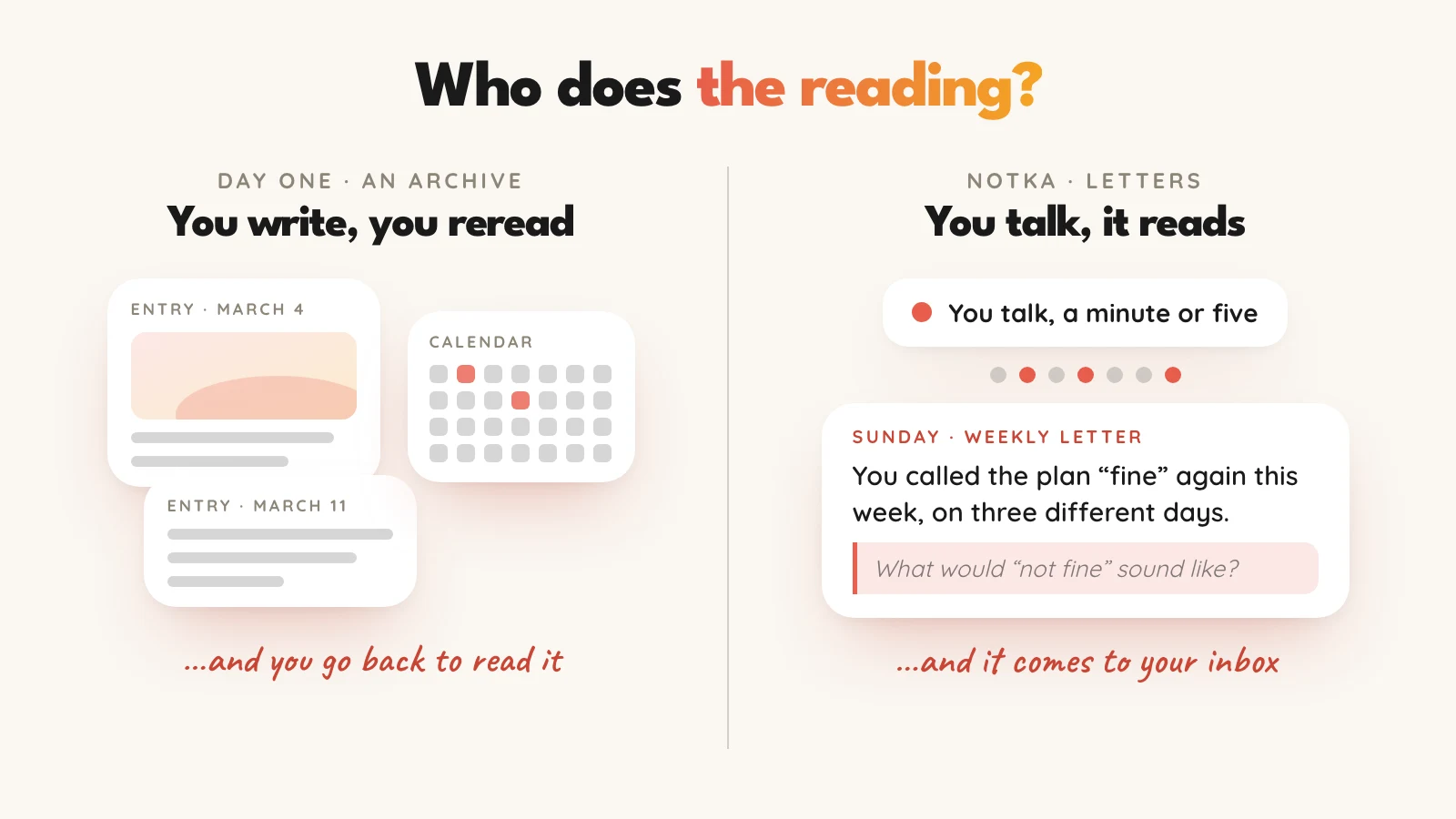
Here is how the two line up. Day One facts are as of September 2026, from its pricing and features pages.
| Day One | Notka | |
|---|---|---|
| Main way in | Writing, plus photos, video, drawings, audio | Talking (text notes too) |
| Voice recording and transcription | Silver and Gold plans | Every plan |
| AI | Daily Chat, summaries, prompts (Gold) | Daily and weekly letters |
| Who does the reading | You, with On This Day, search, map | Notka, in letters to your inbox |
| Platforms | iPhone, iPad, Mac, Watch, Android, Windows, web | Web recorder, iPhone Shortcut |
| Photos, printed books, integrations | Yes | No |
| Paid plan | $49.99 or $74.99 a year | $9 a month or $90 a year |
| Free plan | Unlimited text, 1 photo per entry | 15 min of voice a month, unlimited text |
Notka does much less than Day One, on purpose. It has no photos, no map, no templates, no book printing and no Android app. What it has is the part Day One leaves to you: reading everything you said and writing back about it. If you are also weighing other journals, we compared Notka with Rosebud and AudioPen the same way.
Who should stay on Day One?
- You already write. If you have a streak or a library you care about, Notka would be a step down.
- Your journal is visual. Photos, trips, places and a printed book at the end are Day One's home ground.
- You want to guide the AI yourself. Daily Chat's back-and-forth, with you editing the final entry, suits people who like to shape the record.
- You live across devices. Mac, Watch, Android and Windows apps matter if you journal on all of them.
Who is Notka for?
People who have tried to journal and keep stopping, not for lack of things to say but because the writing is one more job at the end of the day. If you would talk for two minutes but never type for ten, and you would read a letter about your week but never reread your own entries, Notka fits how you already are.
Nothing stops you using both: Day One for photos and trips, Notka for the days you just want to say out loud.
Here is what a Sunday letter looks like.
Example letter
Written by Notka for James, a fictional test persona – not a real user.
You made dinner, watched your show, and called it feeling a bit better.
This week reads like you're building a small toolkit for the overwhelming days – one evening it's dinner and your show on 2026-03-17, another it's five miles in Prospect Park to clear your head on 2026-03-21.
On March 17 you wrote: "I took some time to reflect and just focus on self-care. Made a nice dinner and watched a bit of my show." You said it plainly – "It's nice having those moments, especially when things get overwhelming."
What does 'one day at a time' look like tomorrow?