By Notka ·
Journaling for overthinking: how to get a looping thought out of your head
Journaling for overthinking helps when it gets a loop out of your head and shows you it repeats, not when it replays it. How to do it, and its limits.
Journaling helps with overthinking when it gets the thought out of your head and onto something you can look at later, and it stops helping when it becomes one more place to replay the same argument. Keep entries short, put the loop somewhere with a time limit, and look back once a week for what repeats. The looking back is the part most people skip, and it's the part that shows you the thought isn't new.
Why does the same thought feel new every night?
Because you only ever meet it one round at a time. At 1am the worry about the email you sent, or the thing your sister said, arrives with fresh urgency. It feels like a problem you haven't solved yet, so you start solving it again. You don't remember that you had the same conversation with yourself on Tuesday and last Thursday, and that it ended in the same place.
Psychologists call this pattern rumination: going over the same distressing thoughts and their causes without moving toward an answer. A 2008 review by Susan Nolen-Hoeksema and colleagues describes evidence that rumination enhances negative thinking, impairs problem solving and gets in the way of actually doing things (Nolen-Hoeksema et al., 2008). The same review draws a line between rumination and more adaptive forms of self-reflection. That line matters for journaling, because a journal can land on either side of it.
Does writing about it actually help?
Somewhat, and less than the internet suggests. The best summary we have is a 2006 meta-analysis by Joanne Frattaroli that pooled 146 randomized studies of "experimental disclosure": people writing or talking about personal, meaningful topics. It found a real, positive effect, with an average effect size of r = .075 (Frattaroli, 2006). That is small. It means putting things into words tends to help a little, on average, across a lot of people. It does not mean a notebook will fix a hard month.
One study points at why it can help overthinkers in particular. Researchers asked college students who were vulnerable to depression to write on three consecutive days, either expressively or in a control condition. Six months later, students who tended to push their feelings down had fewer depression symptoms if they had done the expressive writing, and the benefit ran through a drop in brooding, not in reflection, as measured by a standard rumination questionnaire (Gortner, Rude & Pennebaker, 2006). It was one group of students, and it proves nothing about you. It does suggest the useful part is getting a thought out, rather than going around it once more.
Can journaling make overthinking worse?
Yes, and it's worth knowing before you start. In a study of 90 adults who had recently separated from a spouse, people were randomly assigned to one of two kinds of expressive writing or to control writing. Up to nine months later, those who were actively searching for meaning in the separation reported worse emotional outcomes if they had done either kind of expressive writing, compared with control writing (Sbarra et al., 2013).
The plain reading: if you are already stuck on "why did this happen," writing about it can become another lap. A journal that only replays the loop in more detail is rumination with a pen. You can keep writing and change what the entry is for.
How do you journal for overthinking without feeding the loop?
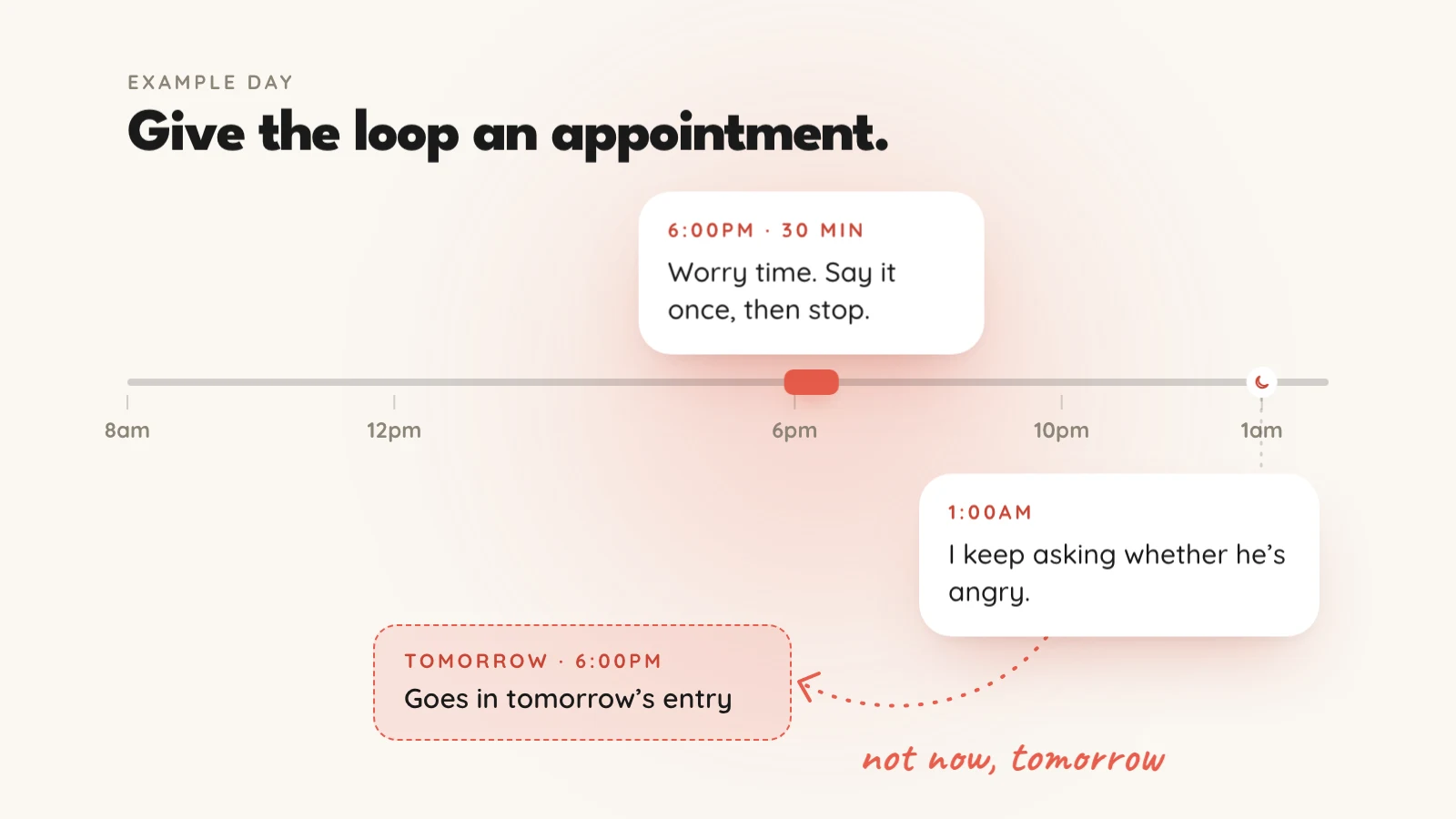
- Give the loop an appointment. In a small study of 53 people with high levels of worry, those trained to keep their worry to a 30-minute period each day, at a set time and place, saw bigger drops in worry, anxiety and insomnia over two weeks than a group told simply not to avoid their worry (McGowan & Behar, 2013). The authors call the evidence preliminary. Your journal can be that appointment: when the thought shows up at 1am, tell yourself it goes in tomorrow's entry.
- Say it once, then stop. A minute or five. Get the whole thought out in one go, including the worst version. When you notice you're repeating yourself, that's the end of the entry, not a reason to keep going.
- Name the fact, the feeling and the question. "I snapped at Tom in the meeting. I feel embarrassed. I keep asking whether he's angry." Three sentences are enough to recognise the loop next time.
- Don't reread every night. Rereading last night's worry at bedtime is a replay. Leave the entries alone.
- Look back once a week. This is the step that changes things. Read the week together and ask: which thought came up more than once? Did the thing I dreaded on Tuesday happen?
Why is talking easier than writing when your head is full?
When you're overthinking, a blank page asks for one more decision: what is this entry about? Talking skips that. You can start in the middle, ramble, contradict yourself and find the point halfway through, which is how a looping thought actually sounds. A voice note also finishes: you stop talking and it's out of your head and somewhere else. If your head is full of many things rather than one loop, a brain dump is the better first move.
When is a journal not enough?
If the thoughts are getting darker, keeping you from sleep night after night, or making it hard to get through the day, a journal is not enough on its own. Talk to someone you trust, and talk to a doctor or a mental health professional. A journal can hold a thought. It can't look after you.
How Notka handles the loop
The hard part of step five is that you're the one doing it. You were there for every night of the loop, so each round still feels like the first, and few people reread a week of entries anyway.
Notka is a journal you talk to. Press record on the web, or the one-press Shortcut on your iPhone, and say the thought for a minute or five. That's the whole entry. After a day with something to say, a short letter arrives the next morning. On Sunday a wider one reads the week back to you in your own words and dates, so the worry from Tuesday and the same worry from Friday sit next to each other where you can see them. It doesn't tell you what to do about it. It asks a question you might not have asked yourself. See how it works.