By Notka ·
Expressive writing: what the research actually says
Expressive writing is a research protocol: 15 to 20 minutes about something upsetting, three to five times. What the studies measured, and how small the effect is.
Expressive writing is a research method, not a diary habit: you write your deepest thoughts and feelings about something upsetting for 15 to 20 minutes, three to five times, and then you stop. It started with a 1986 study of 46 students. Across 146 later studies the average effect is real, and small. Below: what the studies measured, what they found, and what an everyday journal can borrow.
What is expressive writing?
In the research, the term names one specific task. A 2005 review by Baikie and Wilhelm describes it: participants "are asked to write about such events for 15–20 minutes on 3–5 occasions", often on consecutive days, while a control group writes about neutral topics such as a particular room or their plans for the day. "No feedback is given on the writing" (Baikie & Wilhelm, 2005).
That matters whenever you read a headline about "the science of journaling". Most of that science is about this protocol: a few short, timed sessions about one hard thing. It isn't about keeping a diary for years, and its findings don't carry over to one by default.
What did the first study find?
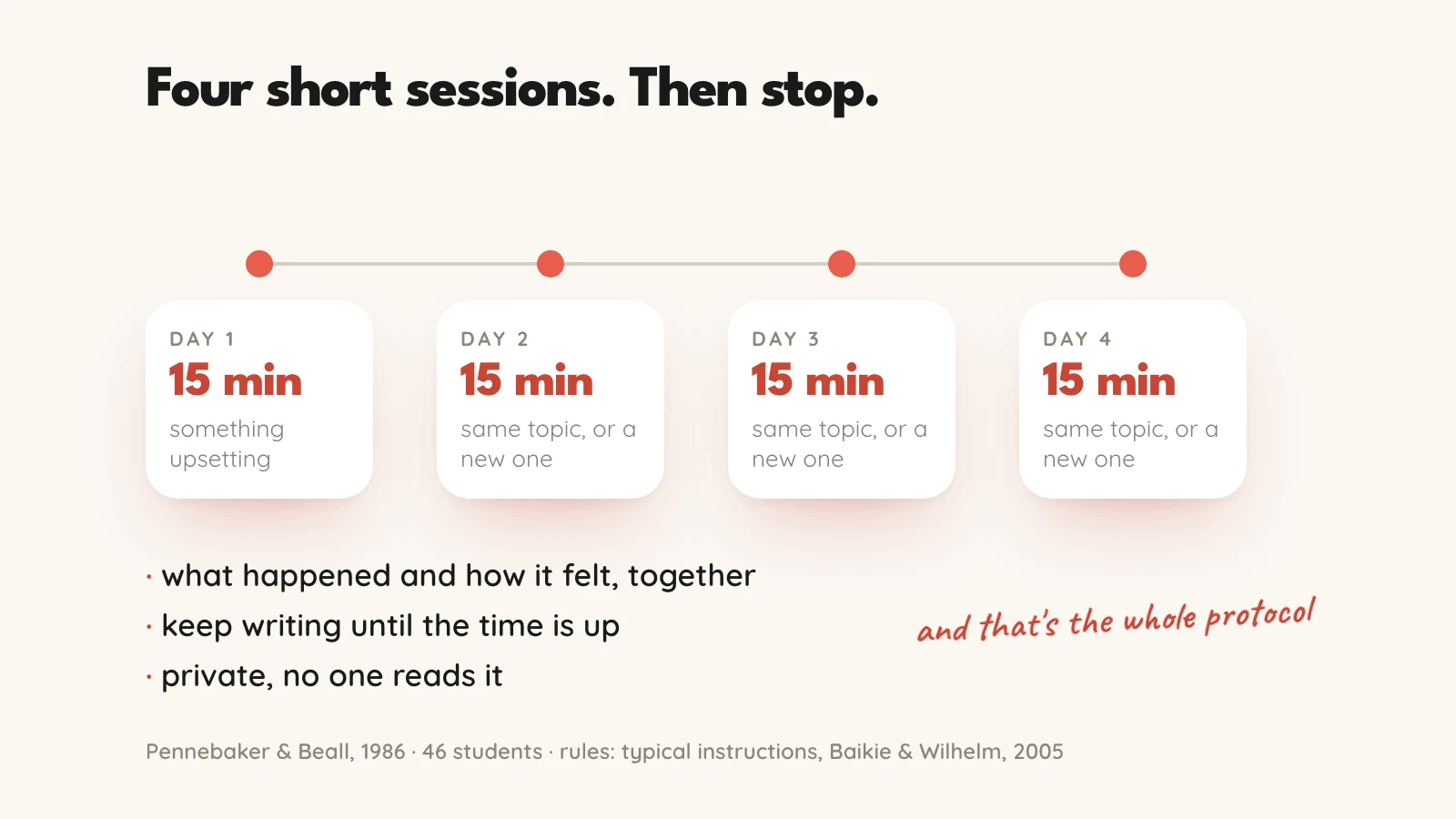
James Pennebaker and Sandra Beall ran it with 46 introductory psychology students. Each one wrote either about personally traumatic life events or about trivial topics, on 4 consecutive days (Pennebaker & Beall, 1986). The sessions were 15 minutes long, and the instruction was to write about "the most traumatic or upsetting experiences" of their entire lives (Baikie & Wilhelm, 2005).
The researchers measured blood pressure, mood and physical symptoms during the experiment, and pulled health centre records afterwards. Students who wrote about both the facts and the emotions of the event had "relatively higher blood pressure and negative moods following the essays, but fewer health center visits in the 6 mo following the experiment." The authors called their findings preliminary.
One detail from that study shaped everything after it: writing only about the emotions did not work as well as writing about the event and the emotions together (Baikie & Wilhelm, 2005).
Does expressive writing make you feel worse at first?
In the short term, usually yes. The same review: "The immediate impact of expressive writing is usually a short-term increase in distress, negative mood and physical symptoms, and a decrease in positive mood compared with controls." Many participants said the writing upset them, and many also found it valuable and meaningful.
The review also notes that the later benefits were unrelated to how much distress people expressed or reported right after writing, and that there is little support for the idea that it works by venting. So feeling rattled after a session was the normal result in these studies, not a sign it went wrong, and feeling worse was never the point. The protocol in clinical use tells people they can stop writing at any time.
How big is the effect?
The largest meta-analysis is Jo Frattaroli's from 2006. She collected 146 randomized studies of experimental disclosure and found that it "is effective, with a positive and significant average r-effect size of .075", with a number of moderators: it worked better under some conditions than others (Frattaroli, 2006).
An r of .075 is small. Run it through the standard conversions:
- Squared, it is about 0.006: which group someone was in accounts for roughly half a percent of the differences in their outcomes.
- On the d scale that compares two group averages, it is about 0.15. Draw two bell curves that far apart and they overlap by about 94%.
- Pick one person from the writing group and one from the control group at random. The writer comes out ahead about 54 times in 100, against 50 for a coin flip.
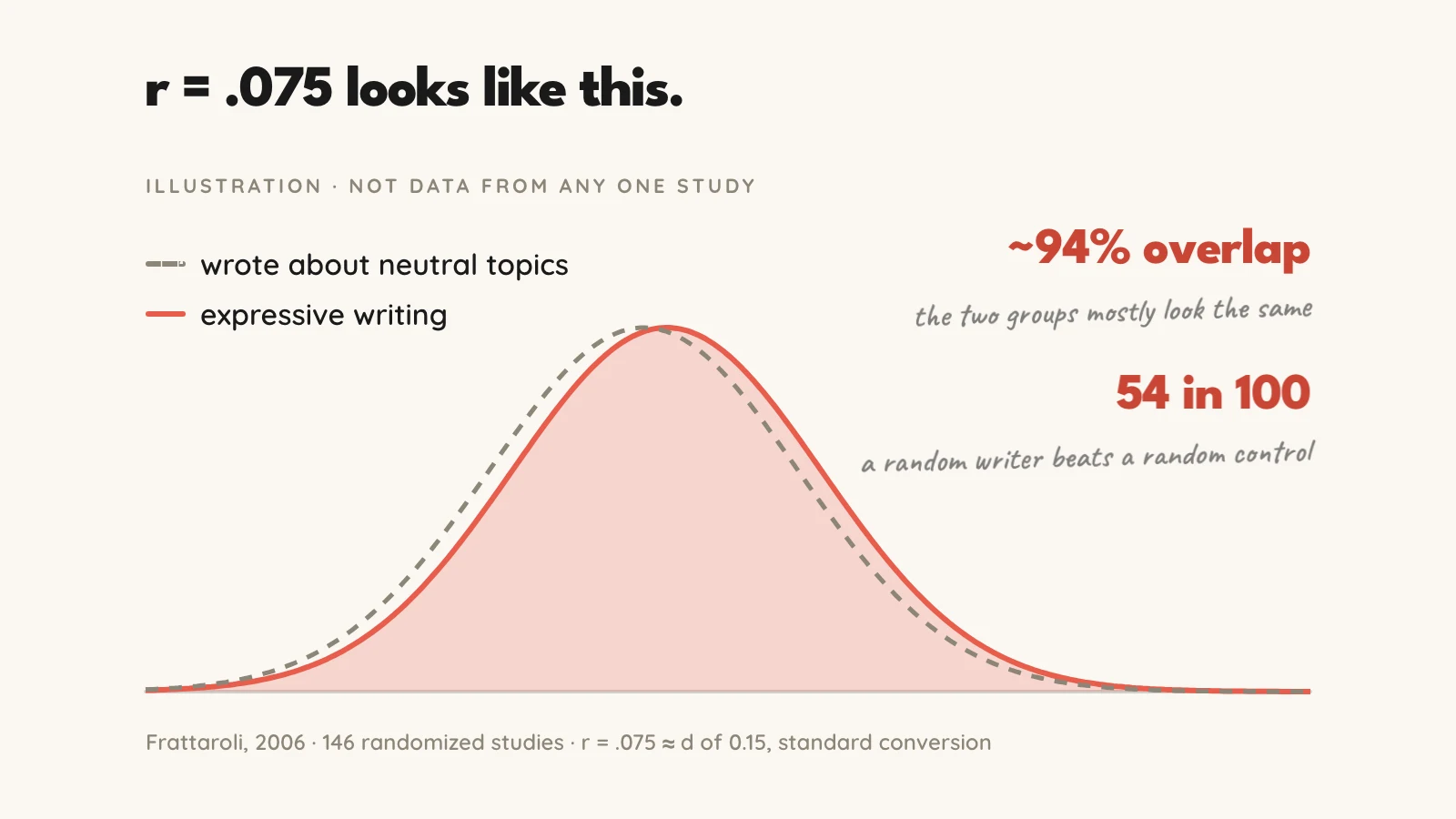
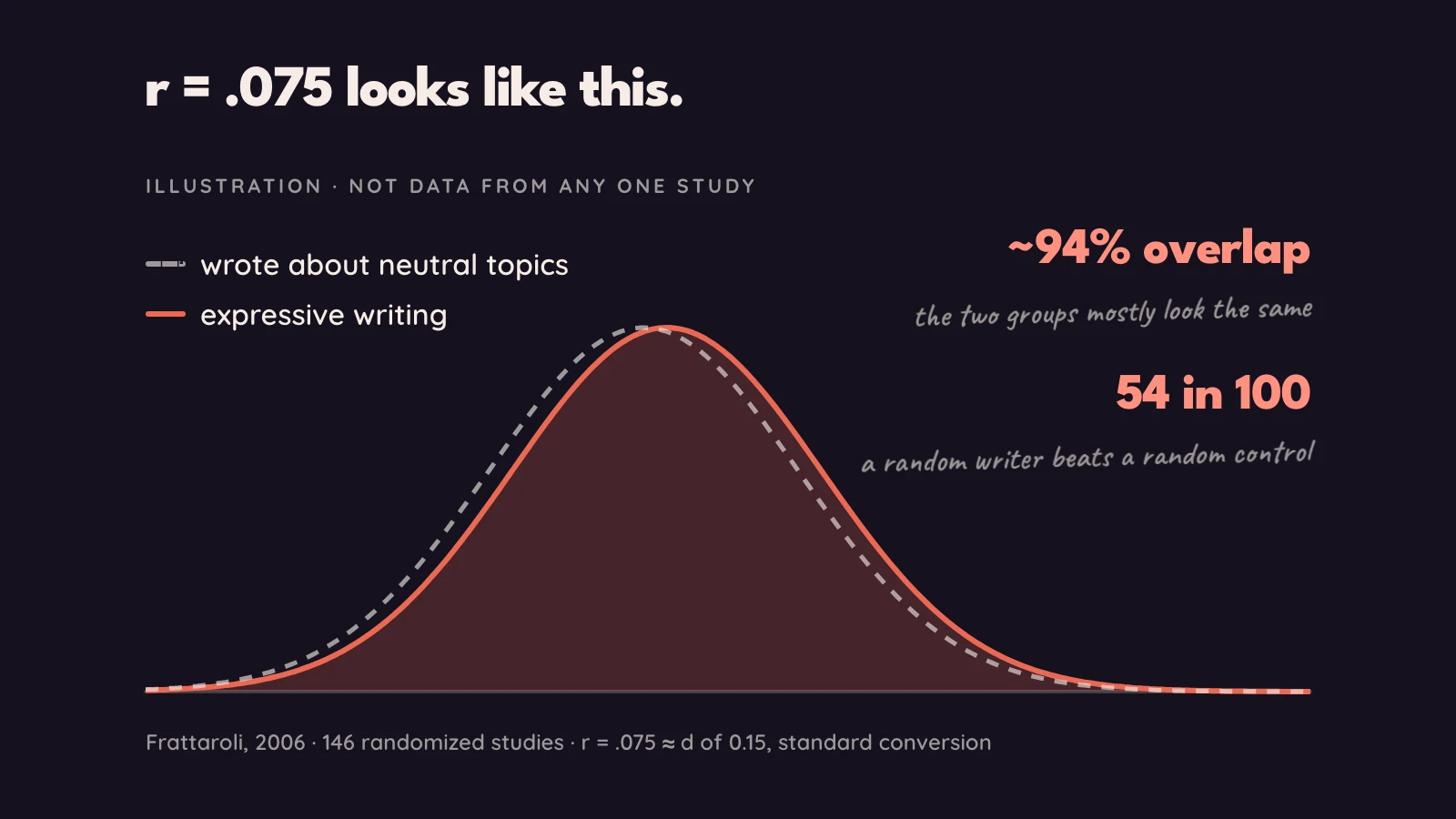
Small on average doesn't mean nothing, and it doesn't mean everyone gets a little. It is an average over many outcomes and many kinds of people, which is why the moderators matter.
Did every review agree?
No. A meta-analysis by Mogk and colleagues, also from 2006, kept only randomized controlled trials and could use 30 of them. "Neither regarding somatic nor psychological health variables significant effect sizes were found," and the authors concluded that expressive writing "has minor or no effects on the subject's health contrary to earlier findings" (Mogk et al., 2006).
The honest summary: early single studies looked stronger than the later averages. The biggest review found a small effect, another found none on health measures.
Does it have to be writing?
One study let people talk instead. Esterling and colleagues randomly assigned 57 healthy undergraduates to write or talk about stressful events, or to write about trivial events, in three weekly 20-minute sessions (Esterling et al., 1994). The talking group ended with lower antibody levels to a common latent virus than the writing group, which in turn was lower than the trivial-writing group. In a content analysis, the talking group also showed the most cognitive change and adaptive coping.
The limits are large: 57 students, one lab, 1994, and a blood marker rather than how people felt or how often they were ill. It shows that speaking was tested and held up in that one study. It doesn't show that talking into a phone is the same thing.
The original protocol, step by step
This is the task as the research describes it (Baikie & Wilhelm, 2005):
- Choose the subject yourself. The most upsetting experience you can think of, or an emotional issue that is affecting your life now.
- Set a timer for 15 to 20 minutes.
- Write the event and the feelings. Let go and explore your deepest thoughts. You can tie it to your relationships, your past, your present or your future.
- Don't stop to fix anything. Spelling and grammar don't matter. The only rule is that once you begin, you continue until the time is up.
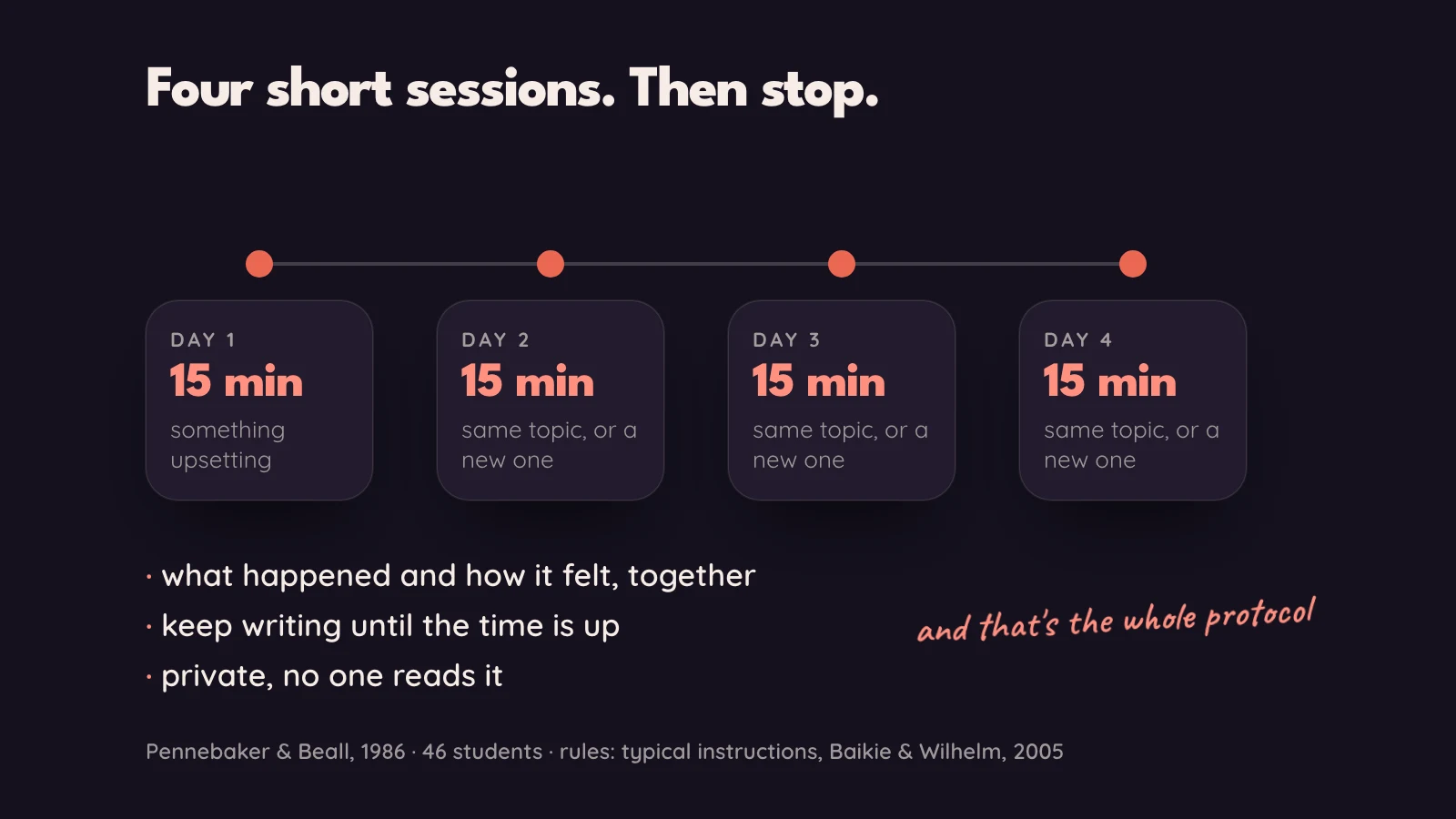
- Repeat on three or four occasions, usually consecutive days. Same topic each time, or a different one.
- Keep it private. No one reads it and no one gives feedback.
- Stop whenever you want to.
What can everyday journaling borrow from it?
The protocol is short on purpose, and a few of its parts travel well:
- Facts and feelings together. Not just "I'm furious", but what happened and what about it got to you. The first study found that combination mattered.
- A boundary. The sessions ran 15 to 20 minutes, not an hour. A session with an end is easier to start and easier to leave.
- Privacy. Write as if no one will read it, because in the studies no one did.
- Not every day. The research is a few sessions about one heavy thing, not a nightly duty. An ordinary journal can hold the ordinary days, and the expressive kind is for when something is sitting on you.
What it can't borrow is the evidence. The studies tested this protocol, and a diary isn't it. And if the same paragraph comes out of you every time, that is closer to a loop than to disclosure.
Where Notka fits
The studies were about putting feelings into words, and the page was just where the words went. Notka is a voice journal that writes back: you talk for a minute or five, into the recorder on the web or with a one-press Shortcut on your iPhone, and the next morning a short letter reads back what you said. Nobody has studied Notka, and it isn't the protocol. It is a low-effort way to put a hard day into words while it's still close, and read it back later. See how it works.