By Notka ·
Brain dump: what it is, how to do one, and what to do with it after
A brain dump means getting everything in your head out onto a page or a recording, unsorted. How to do one, voice or paper, and why the pile matters later.
A brain dump is getting everything that's in your head out, fast and unsorted, onto a page or into a recording. Tasks, worries, half-ideas, the thing you forgot to reply to. You don't rank it or tidy it while it comes out. The point is to stop carrying it, so your head has room for whatever you're doing next.
What is a brain dump for?
Mostly for the moments when your mind feels crowded. Before bed, when tomorrow's list keeps replaying. On a Sunday evening, before the week starts. After a meeting that left you with six loose ends and no clear first step.
The idea is simple. Things you still have to do don't sit quietly in memory; they keep coming back up. Putting them somewhere you trust lets you stop rehearsing them. The dump itself doesn't solve anything. It moves the pile from your head to somewhere you can see it.
Does a brain dump actually help you sleep?
There is one careful study on a close cousin of the brain dump. Researchers at Baylor University and Emory University brought 57 healthy young adults, aged 18 to 30, into a sleep lab and measured their sleep with overnight polysomnography. Before lights out, each person spent five minutes writing, with paper and pencil. Half were randomly assigned to write a to-do list for the next few days; the other half wrote about tasks they had already finished. The to-do group fell asleep significantly faster, and the more specific their list, the faster they fell asleep (Scullin et al., 2018).
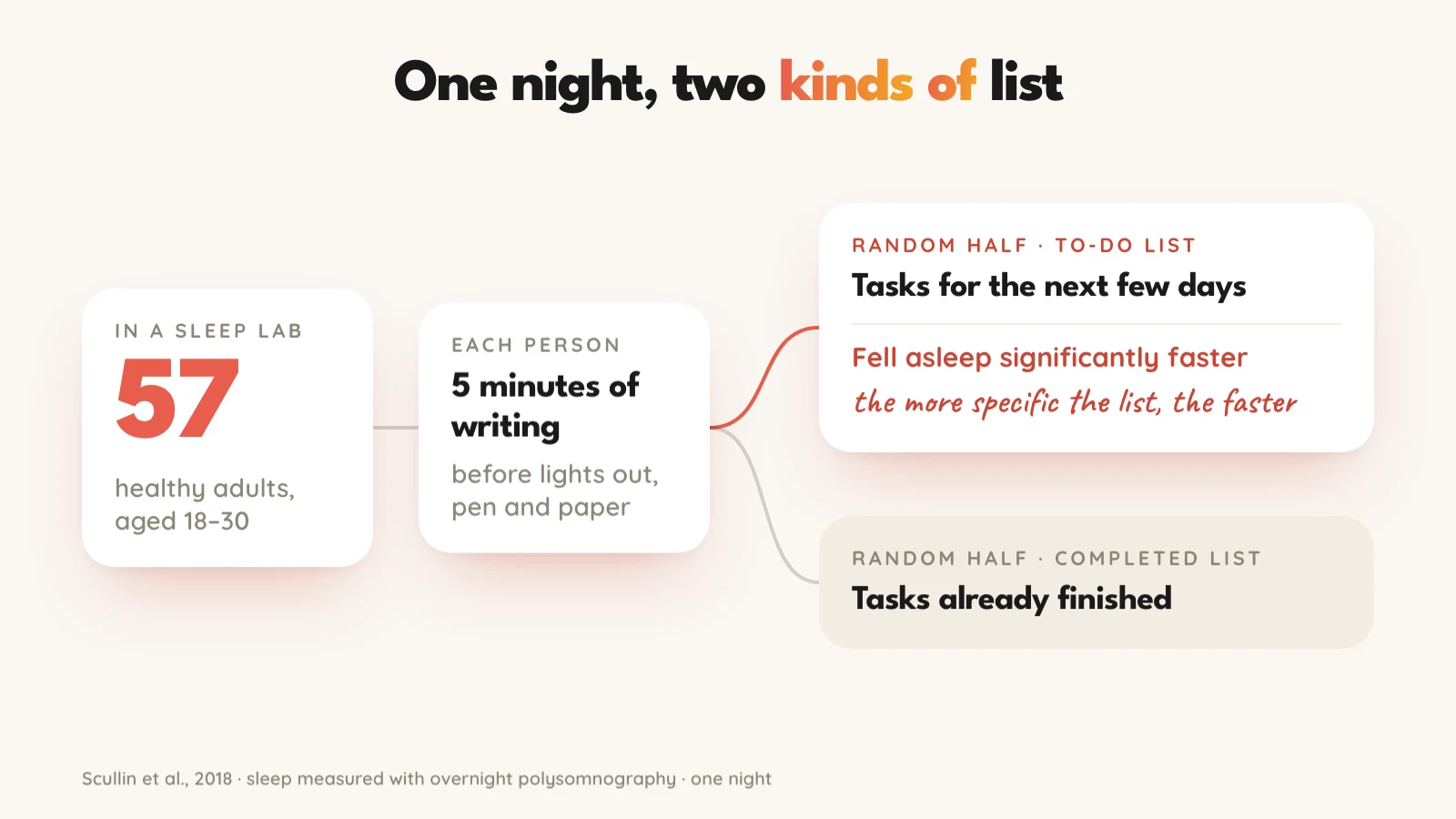
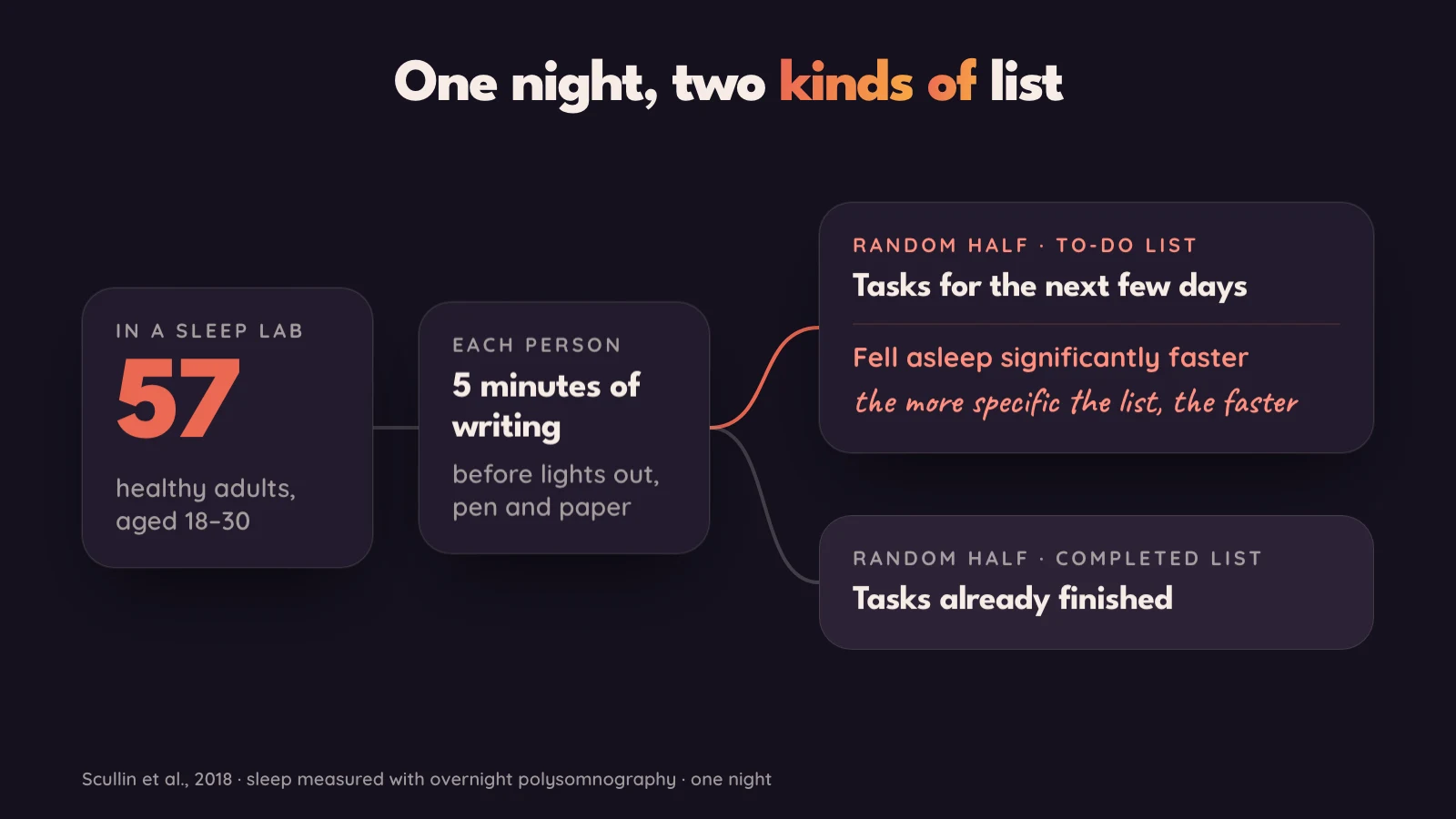
Keep its limits in mind. It was one night, in a lab, with healthy students, and it compared two kinds of writing rather than writing against nothing. It says a specific list of what's ahead beat a diary of what's done, for those people, that night. It doesn't promise you better sleep. It does suggest the future-facing, specific part of a brain dump is doing real work.
How do you do a brain dump?
- Set a short limit. A few minutes is enough. The study above used five. A limit stops it turning into a planning session.
- Get everything out before you judge any of it. "Book the dentist" and "I'm not sure I want this job" can sit next to each other. Sorting comes later, or never.
- Be specific about what's coming. "Email Anna about the invoice on Thursday" does more than "work stuff". Specific items are the ones your head can actually let go of.
- Include the things that aren't tasks. The worry, the odd comment someone made, the idea you had in the shower. They take up the same room.
- Stop when it slows down. You don't need to empty yourself completely. When the next item takes effort to find, you're done.
- Pick out the one or two things for tomorrow. Everything else can stay in the dump. It's not a list you owe anything to.
Should you brain dump on paper or by voice?
Either works. The study above used pen and paper, and nobody has run the same experiment with voice, so there's no evidence that one beats the other for the effect itself.
The difference is friction. Writing by hand makes you slow down, which some people like, because it gives each thought a second. It also means the dump stops at whatever your hand can keep up with. Talking is faster: in a lab study on phones, people entered short English messages about three times faster by speaking than by typing on the keyboard (Ruan et al., 2016). That measured copying text under ideal conditions, not rambling at 11pm, but the direction holds. When you're tired, the method that takes less effort is the one you'll actually use. If talking is new to you, start with how voice journaling works.
A rough rule: paper if you want the dump to double as quiet time, voice if the dump keeps not happening because writing feels like a chore. Voice also works on the walk home, in the car, or with your hands full, which is often when your head is loudest.
What should you do with a brain dump afterwards?
This is where most advice stops, and where most of the value is.
One dump helps once. You feel lighter, you pull out the thing for tomorrow, and you move on. But dumps pile up. After a few months you have dozens of pages or recordings, and you'll almost never go back to them. Rereading your own mess is slow, a bit embarrassing, and there's always something more urgent.
The pile holds something no single dump does. The same person keeps appearing in your Sunday dumps. A task you "just need to do" shows up for the fourth week running. The worry you called minor in one dump turns out to be in half of them. None of that is visible from inside one entry. It shows only when someone reads them together, and you're badly placed to be that reader, because you were there and it all felt normal at the time.
If you keep a paper habit, you can do a rough version of this yourself: once a month, flip back through and mark anything you've written down more than twice. It's tedious, and most people give up on it. It's still worth trying once, just to see what turns up.
How does Notka handle the part after the dump?
Notka is built around that second half. You dump by talking, into the recorder on the web or a one-press Shortcut on your iPhone, for a minute or five. Text notes work too, if you're somewhere you can't talk. Notka transcribes it and keeps it.
Then it does the rereading you weren't going to do. After a day with something to say, a short letter arrives the next morning. On Sunday a longer one looks back at your week in your own words and dates, and points at what came up more than once. It doesn't tell you what to do about any of it. It asks a question, usually about the thing you kept mentioning and never stopped to look at.
So the dump still does its first job: it gets things out of your head tonight. The letters do the second job, which is noticing what keeps coming back. More on the capture side is on the brain dump page.