By Notka ·
Voice journaling: how to keep a journal without writing a word
Voice journaling means saying your day out loud instead of writing it down. Why it sticks when a notebook doesn't, how to start, and what to do with the recordings.
Voice journaling is keeping a journal by talking. You say what happened, what bothered you and what you keep circling back to, and a recording or a transcript holds it instead of a page. It works for people who stall at the blank page, because it asks for a minute of talking, not a finished paragraph.
Why a written journal stops in week two
You buy the notebook, write three good entries, and then a long Tuesday happens. At 11pm, writing feels like homework. You skip a day, then a week, and the notebook becomes a small reminder that you didn't keep it up.
Speed is part of it. In a lab study by researchers from Stanford, the University of Washington and Baidu, people entered short English messages on a phone about three times faster by speaking than by typing: 153 words per minute against 52 (Ruan et al., 2016). At those rates, a 100-word thought takes about 40 seconds to say and close to two minutes to type. The study measured copying text in ideal conditions, so real life is messier. The gap still points the same way, and at the end of a long day those extra minutes are exactly what you don't have.
Form matters too. A page asks you to decide what the entry is about before you start. Talking lets you ramble first and find the point on the way, which is how most of us think anyway.
Does talking count as journaling?
Researchers have compared the two. In a 1994 study, 57 students were split at random into three groups: one wrote about stressful events, one talked about them, and one wrote about trivial things. Each group did three weekly 20-minute sessions. The talking group did at least as well as the writing group on the study's health measure, and in a content analysis its sessions showed the largest gains in coping, self-esteem and changes in how people thought about what happened (Esterling et al., 1994).
It was a small study of healthy undergraduates, and it proves nothing about you in particular. It does suggest that putting an experience into words matters more than whether you use a pen.
How to start voice journaling
- Pick one trigger, not a schedule. Talk when something is on your mind: after a hard meeting, on the walk home, when a thought won't let you sleep. A fixed daily slot turns the habit into another chore you can fail.
- Keep it short. A minute or five. You can say more tomorrow.
- Say it the way you'd tell a friend. Skip the structure. "Today was weird because…" is a fine first line.
- Name the feeling and the fact. "I was annoyed" plus "because the plan changed again" gives you something to notice later.
- Don't reread every entry. You'll never listen back to most recordings, and you don't have to. Their value shows up when someone, or something, reads them together.
What to talk about when your mind goes blank
You don't need prompts most days, because the reason you pressed record is the prompt. When you do sit there with nothing, try one of these:
- What took more energy today than it should have?
- What did you put off, and what were you waiting for?
- Who did you think about, and why them?
- What would you tell a friend who had your day?
Answer one out loud and stop when you run out. A minute of honest rambling beats a tidy page you never write.
The part a voice memo app misses
Recording is the easy half. A folder of fifty voice memos gives you back what a pile of notebooks does: nothing, unless you sit down and go through them. Few people do.
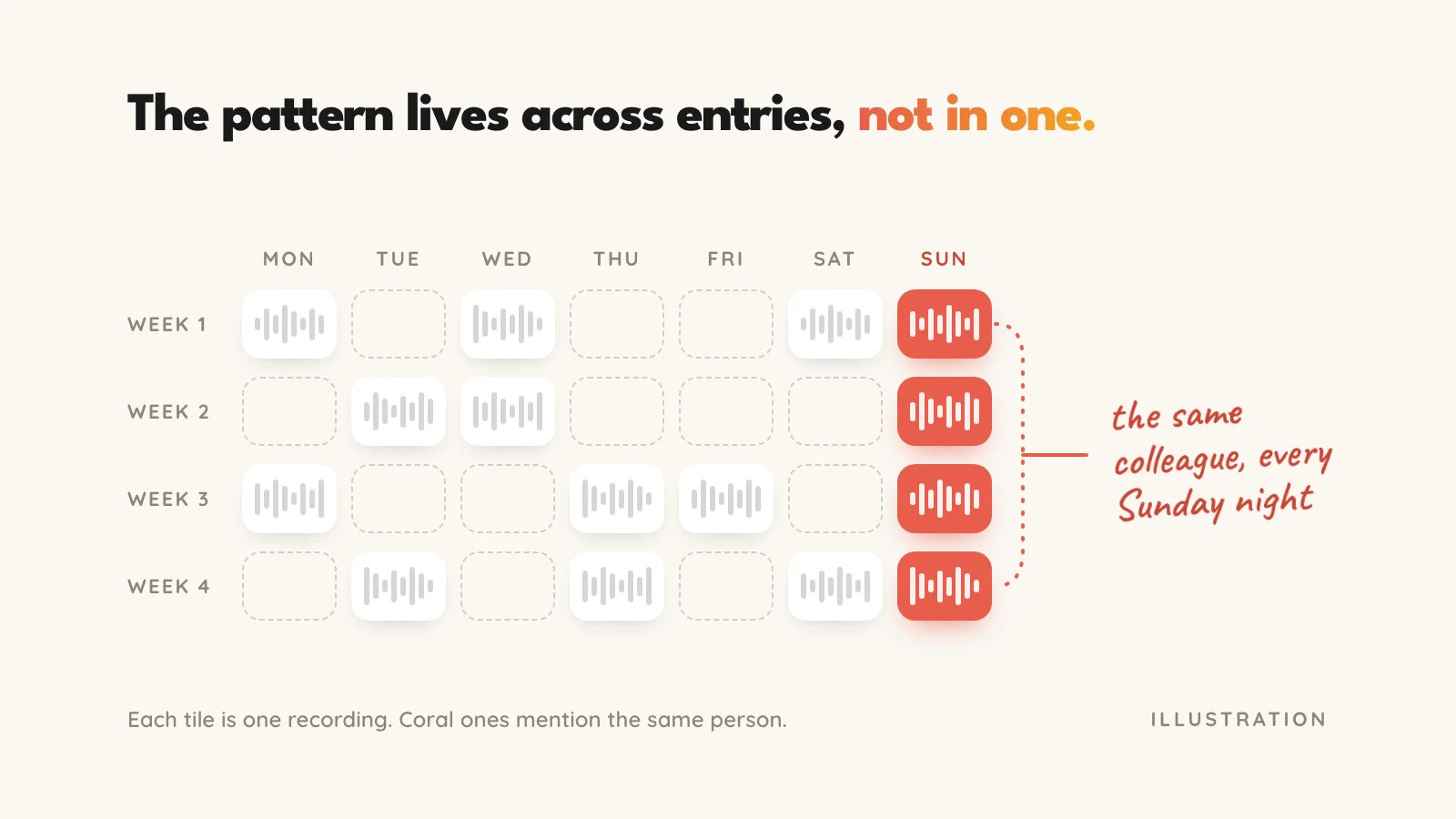
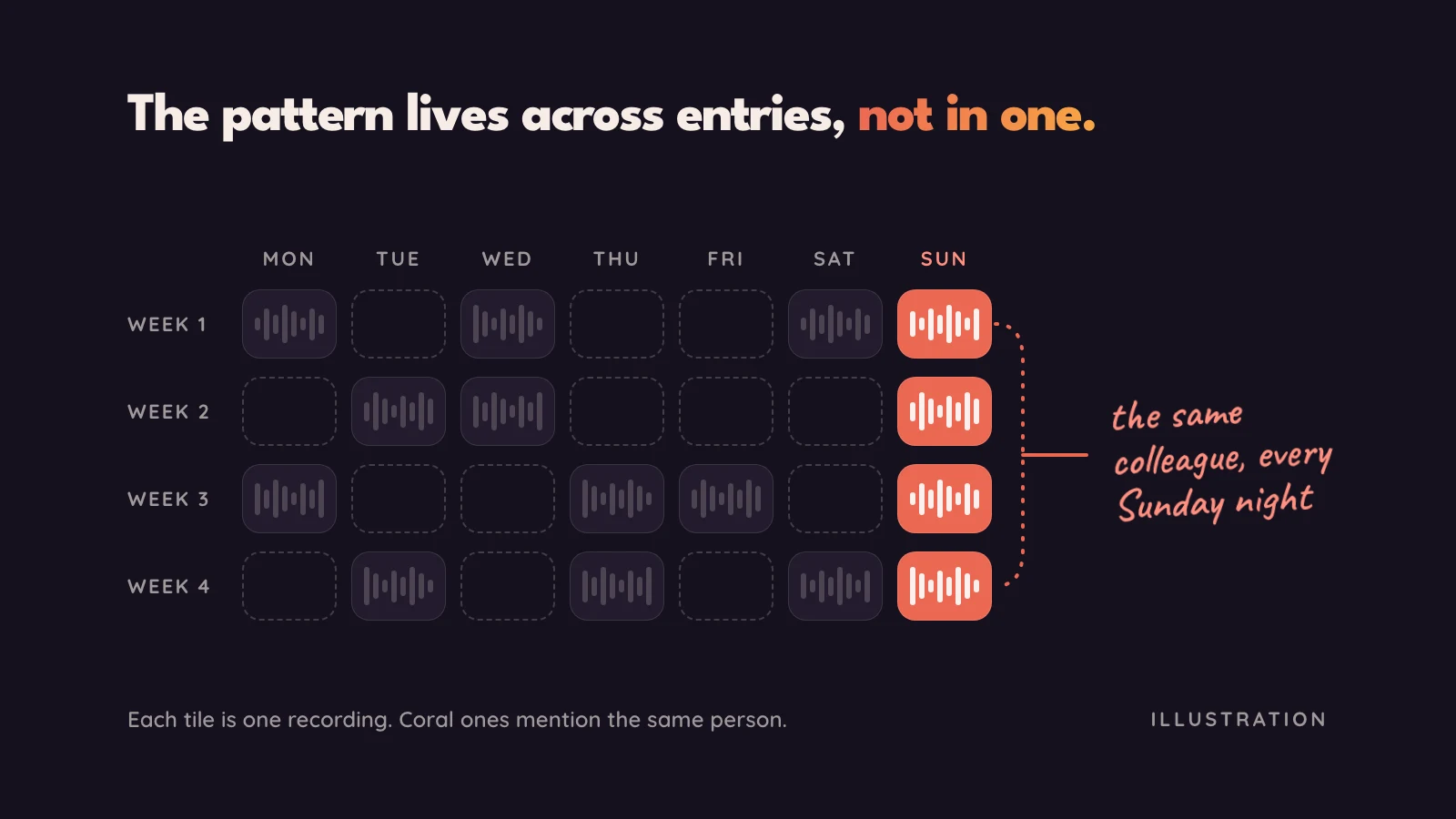
The useful part of a journal shows up later, and across entries. You mention the same colleague every Sunday night. You sound lighter in the weeks you run. A decision you called "fine" in March keeps coming up in May. None of that sits in a single recording. You only see it when all of them get read together, and you're the person least able to do that reading, because you were there.
What Notka does about it
Notka is a voice journal that writes back. You talk into the recorder on the web or a one-press Shortcut on your iPhone, for a minute or five. Notka transcribes it and remembers it. After a day with something to say, a short letter arrives the next morning. On Sunday a wider one looks at your week, using your own words and dates, and points at what repeated. It never tells you what to do. It asks the question you wouldn't think to ask yourself. See how it works.
You never have to open the app to get anything out of it. You bring the moments, and the hindsight comes to your inbox.
Here is what a weekly letter looks like.
Example letter
Written by Notka for James, a fictional test persona – not a real user.
You made dinner, watched your show, and called it feeling a bit better.
This week reads like you're building a small toolkit for the overwhelming days – one evening it's dinner and your show on 2026-03-17, another it's five miles in Prospect Park to clear your head on 2026-03-21.
On March 17 you wrote: "I took some time to reflect and just focus on self-care. Made a nice dinner and watched a bit of my show." You said it plainly – "It's nice having those moments, especially when things get overwhelming."
What does 'one day at a time' look like tomorrow?