By Notka ·
Journaling for ADHD: why the blank page fails and what to try instead
Journaling with ADHD often dies on the blank page and the fixed daily slot. Why, what the research does and doesn't say, and how to journal by talking.
Journaling for ADHD works best when it drops the two things that usually kill it: the blank page and the fixed daily slot. Capture a thought when it shows up, in whatever form costs the least effort, which for many people means saying it out loud. Let the reading back happen later, in one place, instead of asking yourself to reread old entries.
Why do journals fail so often when you have ADHD?
The standard journaling advice assumes a particular kind of brain. Sit down at the same time every night, open the notebook, and write a considered page about your day. Each of those steps leans on something that ADHD makes harder.
The US National Institute of Mental Health lists what ADHD tends to look like in adults: difficulty paying attention and often getting distracted, poor time management and planning, trouble remembering daily tasks, and trouble focusing on a large task (NIMH, ADHD in Adults). A nightly journal is a small daily task you have to remember, at a time you have to plan for, that asks for sustained focus at the end of the day when you have the least of it.
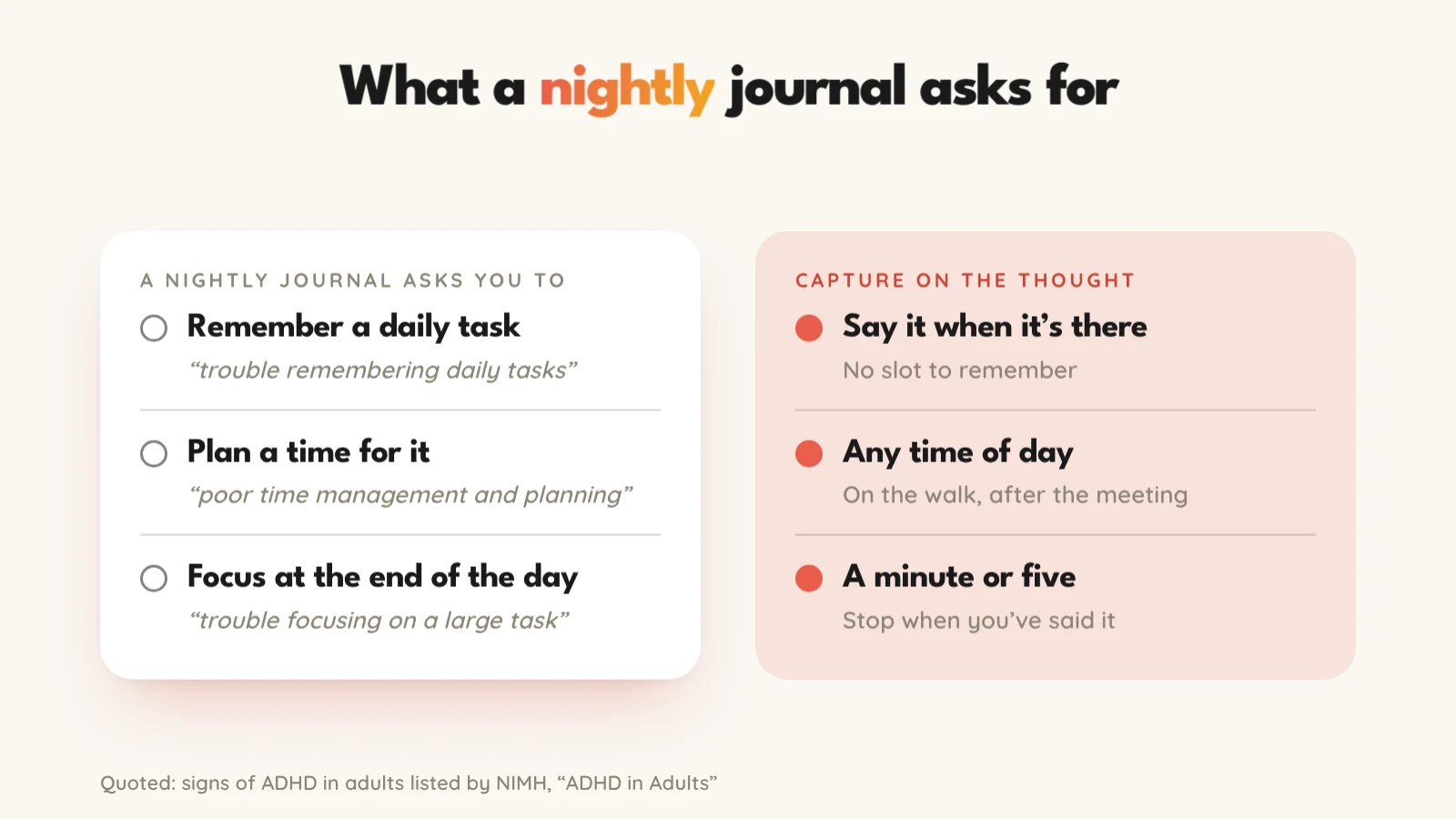
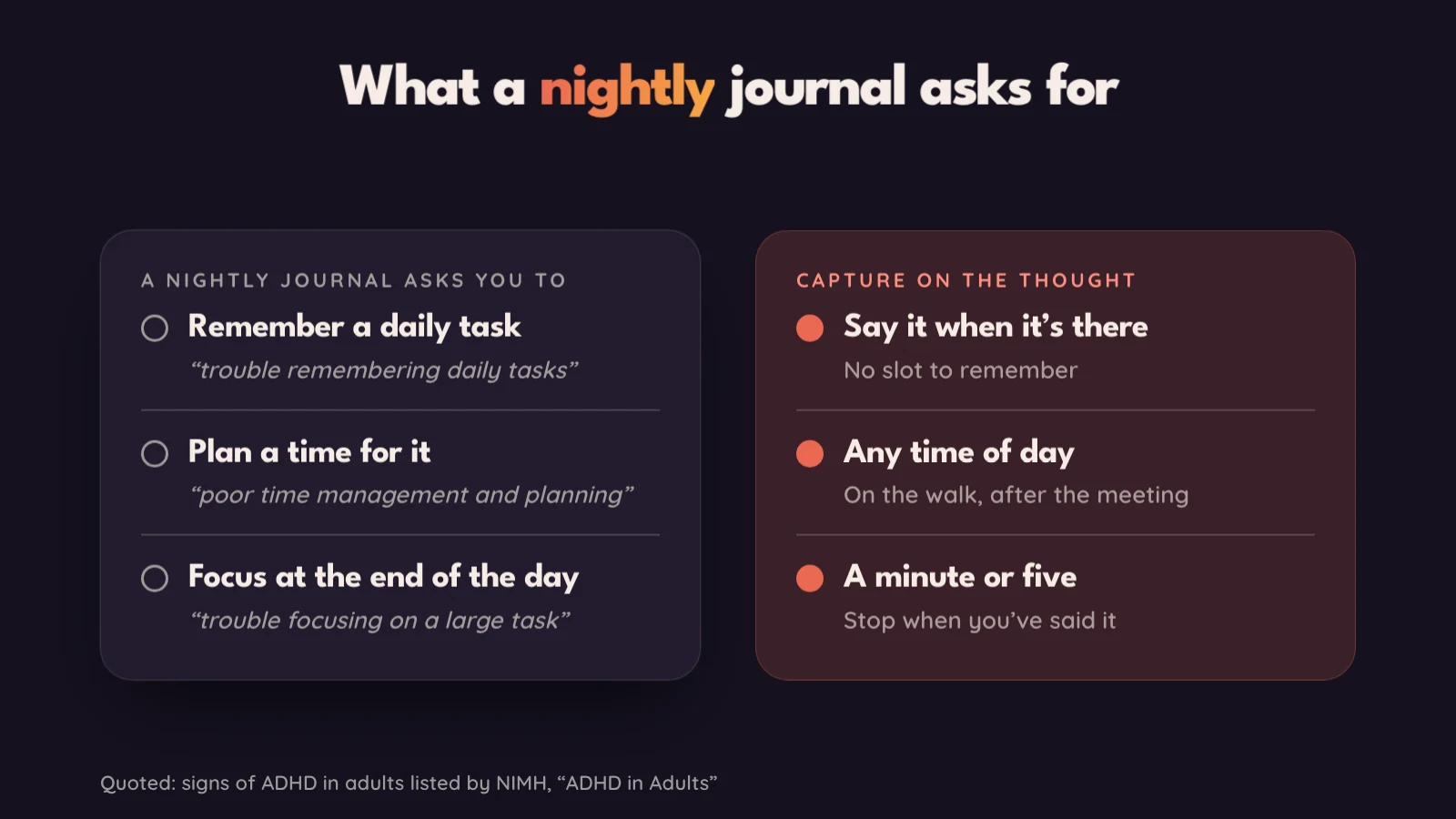
So the notebook goes quiet after a week. That says nothing about your willpower. The method asked for the exact skills that were in short supply.
Is the blank page harder with ADHD?
It can be, for reasons researchers have measured. Writing a journal entry means holding a thought in mind while you find the words, spell them and decide what comes next. That juggling is working memory. A 2013 meta-analysis pooled 38 studies of working memory in adults with ADHD and found moderate-sized differences from people without ADHD, in both verbal and visual tasks. The authors concluded that working memory difficulties persist into adulthood (Alderson et al., 2013).
Writing itself shows the strain in children. In a set of three studies from the University of Padova, the first with 24 sixth- and seventh-grade children whose teachers saw ADHD symptoms in them, those children wrote shorter texts with more errors, and scored lower on structure, grammar and vocabulary than matched children without those symptoms (Re et al., 2007). That was children at school, not adults with a diary, so read it as a hint rather than proof. The hint points the same way: turning a thought into tidy written sentences carries a cost, and a blank page charges it up front.
What does the research say about journaling for ADHD?
Very little. As of September 2026, we could not find a published trial of journaling or expressive writing in adults with ADHD. There is a large body of work on expressive writing in general, but none of it tested people with ADHD as a group, so nobody can tell you that journaling will change your symptoms. Anyone who promises that is guessing.
What the research does describe is the shape of the problem. A King's College London team built a scale for excessive mind wandering and tested it in two studies of adults with ADHD. Mind wandering was higher in adults with ADHD and added to their day-to-day difficulties on top of the core symptoms (Mowlem et al., 2019). If your mind jumps around all day, the thought worth keeping tends to arrive on a walk or in the shower, and it's often gone by 10pm when the journal is supposed to happen.
That is the case for changing the format. It rests on how attention works for many people, not on a promise about outcomes.
How do you journal with ADHD without a routine?
- Capture on the thought, not on the clock. When something is on your mind, record it then. No slot to remember and no streak to break.
- Talk instead of writing. Speaking skips spelling, sentence structure and the pen. You can ramble, backtrack and land on the point halfway through.
- Keep it to a minute or five. Stop when you've said it. Short entries you actually make beat long ones you plan and skip.
- Say one fact and one feeling. "The meeting moved again, and I'm fed up" is enough to be useful later.
- Put the whole thing on one button. Every extra step (unlock, find the app, pick a notebook) is a place for the thought to escape. Fewer taps means more entries.
- Don't make rereading your job. Going back through old entries is a large, open-ended task, which is exactly the kind NIMH lists as hard. Let something else do the looking back.
What should an ADHD journal entry sound like?
Messy, and that's fine. Something like: "Okay, I said yes to the Friday thing again and I don't want to go, and I think it's because I never say no when she asks." No heading, no date written out, no neat conclusion. The value is in the raw version, because it records what you were actually thinking before you tidied it up.
If you blank when you hit record, pick one of these and answer it out loud:
- What pulled your attention away today, and what were you doing when it happened?
- What did you start and not finish?
- What's been on your mind more than once this week?
- What went better than you expected?
Why the reading back matters more than the writing
A journal pays off when you look across entries: the same worry every Sunday, the weeks that felt easier, the task that keeps sliding. But rereading a month of entries is a long, self-directed chore with no deadline, and it rarely happens. That leaves most ADHD journals as a pile of good moments nobody ever reads twice.
Where Notka fits
Notka is a voice journal that writes back. You talk into the recorder on the web, or press a one-press Shortcut on your iPhone (see how that works), whenever something is on your mind, for a minute or five. You can type a note instead when talking isn't possible. After a day with something to say, a short letter arrives the next morning. On Sunday a wider one looks at your week, in your own words and dates, and points at what came up more than once.
It doesn't set a schedule, keep a streak or tell you what to do. It asks a question. Notka is not a tool for ADHD and won't change how your attention works. It takes on the part most journals quietly drop, the looking back, so you only have to do the part that fits: saying it when it's there. For the dump-it-all-out version, see brain dump.