By Notka ·
How to start journaling when every notebook you buy ends up blank
To start journaling, skip the notebook and the daily rule. Tie one small entry to a moment you already have, even a minute of talking, and let it grow.
To start journaling, start smaller than you think you should. Pick one moment you already have, like the walk home or the minute after a hard meeting, and say or write a few lines about what's on your mind. No nice notebook, no daily quota, no rule about length. Let the habit find its shape once it exists.
Why do most people quit journaling so fast?
The usual start looks like this. You buy a good notebook, decide to write every night before bed, and do it properly for four or five days. Then you get home late, skip a night, and the next evening the gap feels like a debt. A week later the notebook lives in a drawer. (If a fixed time has never once worked for you, journaling with ADHD covers why that slot is so fragile.)
Nothing about that is a character flaw. The plan asked for three hard things at once: a fixed time, a finished piece of writing, and an unbroken streak. Any one of them can end it. The notebook itself adds pressure, because a blank, expensive page makes a messy first line feel like a mistake.
So the fix is not more discipline. It's a smaller first step, attached to a moment that already happens.
How long does it take for journaling to become a habit?
Often longer than people expect, and it varies a lot from person to person. In one study, 96 volunteers each picked an eating, drinking or activity behaviour to do daily in the same context, such as "after breakfast", for 12 weeks, and rated every day how automatic it felt (Lally et al., 2010).
Two findings matter for anyone starting a journal:
- The range was huge. The time to reach close to full automaticity ran from 18 to 254 days. Some people get there in a few weeks, and some take most of a year.
- Missing a day didn't break it. Missing one opportunity did not materially affect how the habit formed.
The study looked at eating, drinking and exercise, not journaling, and it was small. It still undercuts the two beliefs that kill most journals: that a habit should feel easy by week three, and that one missed night means you've failed. Repetition in the same context is what did the work, not a perfect streak.
What's the easiest way to start a journal?
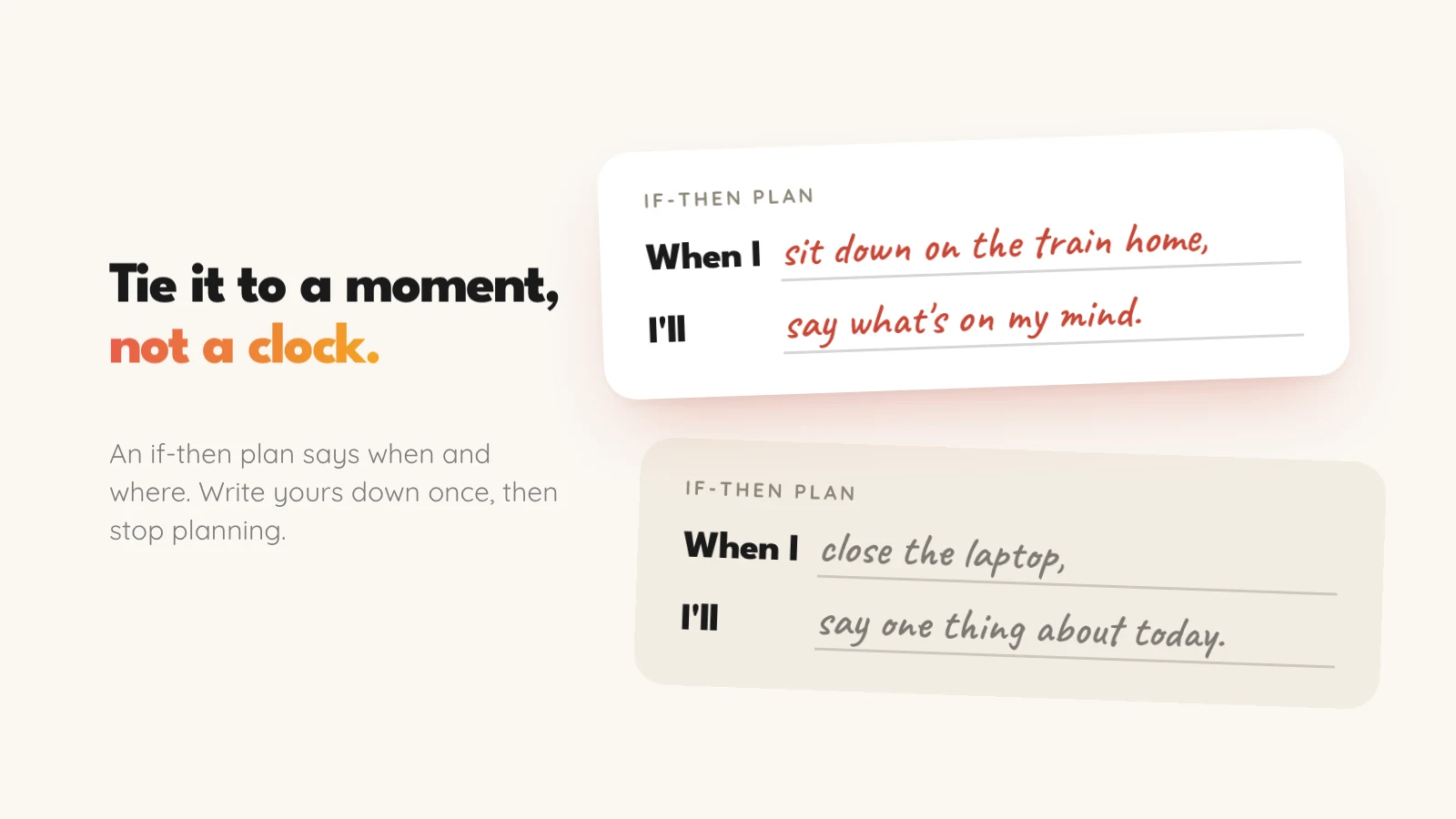
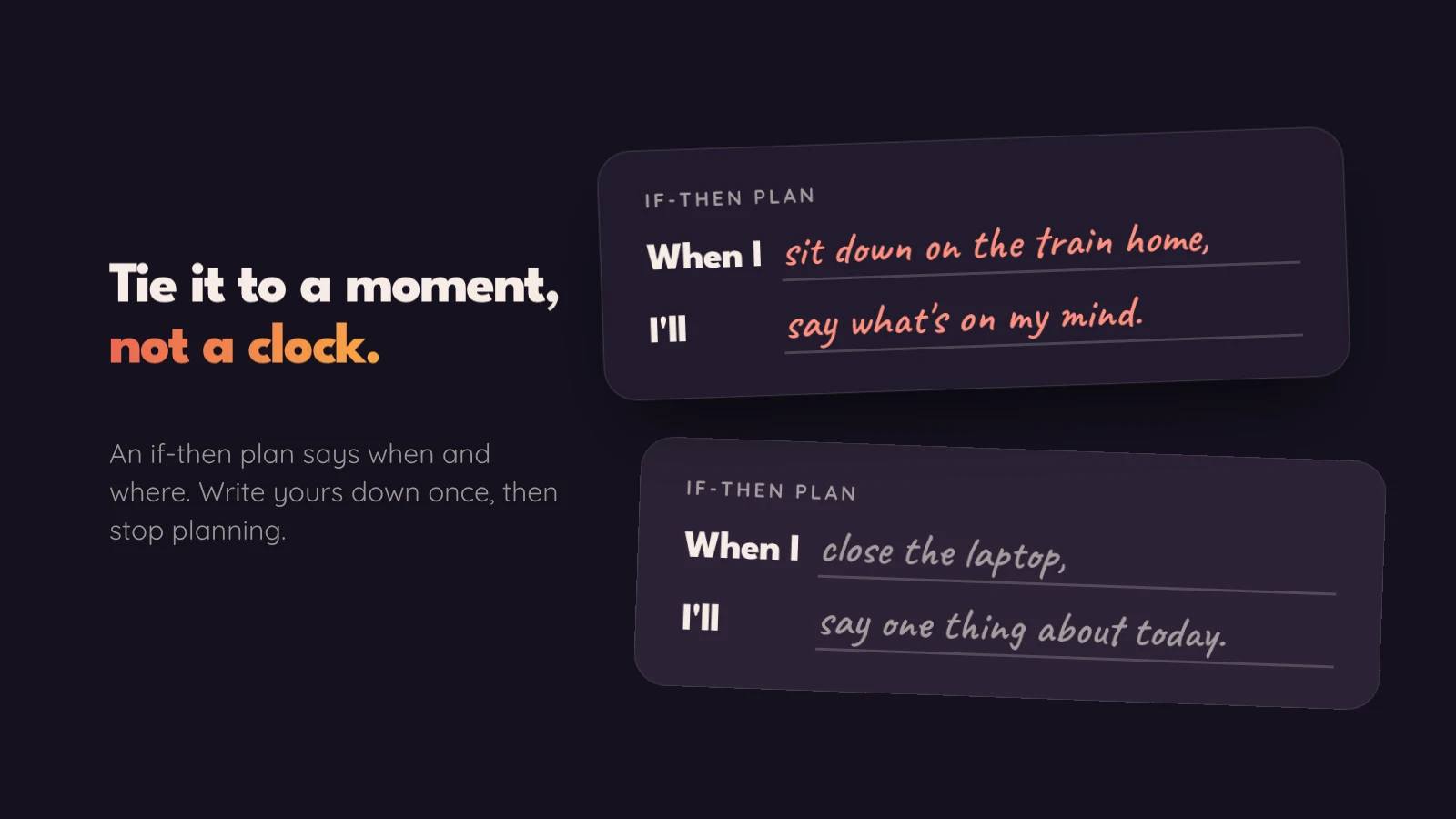
Tie it to a moment instead of a clock. Psychologists call this an implementation intention: an if-then plan that says when and where you'll act, like "When I sit down on the train home, I'll say what's on my mind." A review of 94 independent tests found that plans of this kind had a medium-to-large effect on whether people reached their goals (Gollwitzer & Sheeran, 2006).
That turns "journal every day" into something you can actually follow:
- Choose your "when". Pick a moment that already happens most days: the commute, the kettle, the car before you go inside. Avoid "before bed" if you're usually wiped out by then.
- Make the entry tiny. A few lines, or a minute or five of talking. The goal in the first weeks is showing up, not saying something good.
- Write your if-then down once. "When I close the laptop, I'll say one thing about today." Then stop planning.
- Allow a messy first line. "I don't know what to say, but today felt long" is a real entry.
- Miss days without starting over. Pick it up at the next moment, not next Monday.
- Let it grow on its own. Some days you'll talk for a minute, some days for ten. Don't raise the bar on purpose.
How do you journal when you hate writing?
A lot of people who "can't journal" can think out loud just fine. What they hate is the writing: picking words, fixing sentences, deciding what the entry is about before they start. At the end of a tiring day that's real work.
If that's you, give yourself permission to skip the page. The benefit most people want from a journal comes from putting a day into words and looking at it, and spoken words count. You can ramble, contradict yourself and find the point halfway through, which is how thinking usually goes anyway.
Can you keep a journal without writing anything?
Yes. Voice memos, a recorder, or an app that transcribes you all work. Talking is the easiest first step for many people because it needs no setup: you already talk to yourself in the car or on a walk. Pressing record just keeps it.
If you want more on the talking side specifically, how to do it and what to say, we wrote a separate guide to voice journaling.
What should your first entries be about?
Whatever made you reach for the journal in that moment. If nothing comes, try one of these:
- What's the thing from today you'd mention to a friend?
- What are you still thinking about from this morning?
- What went better or worse than you expected?
Answer one and stop. A short entry you actually make is worth more than a long one you plan for Sunday. If your head is too full to pick one thing, do a brain dump instead, and once you have a few weeks of entries, a weekly reflection is the natural next step.
What happens to all those entries?
Starting small has one cost. The entries work for you in the moment, but they're scattered: a minute here, a few lines there. The patterns only show up across weeks. Maybe you mention the same worry every Thursday, or you sound calmer in the weeks you get outside. You won't see that by rereading, partly because nobody rereads, and partly because you were there, which makes you the worst person to spot it.
How Notka handles the part after you start
Notka is built for exactly this kind of small start. You talk for a minute or five, whenever something is on your mind, into the recorder on the web or the one-press Shortcut on your iPhone. You can type a note instead when talking doesn't fit. There's no streak to keep and nothing to file.
After a day with something to say, a short letter arrives the next morning. On Sunday, a longer one looks back at your week in your own words and dates and points at what repeated. It doesn't tell you what to do. It asks a question you probably wouldn't ask yourself. Those small entries turn into something you can see.