By Notka ·
Reflective journaling: why a weekly look back beats a nightly entry
Reflective journaling means going back over what happened to learn from it. Why it works better with a few days of distance, and how to do a weekly reflection.
Reflective journaling is writing about what happened so you can learn from it, not just record it. A diary says what you did on Tuesday. A reflective entry asks why Tuesday went the way it did, what you felt, and what you'd do differently next time. It works best when you look back from a little distance, which is why a weekly reflection often shows you more than a nightly one.
What makes journaling "reflective"?
The difference is the questions you ask. One well-known framework is Gibbs' reflective cycle, from a 1988 guide to learning by doing. The University of Edinburgh's Reflection Toolkit walks through its six steps: describe what happened, name your feelings, evaluate what went well and badly, analyse why, draw a conclusion, and make an action plan (University of Edinburgh).
The toolkit describes the analysis step as the point where "you have a chance to extract meaning from it." That is the part a plain diary skips. Description tells you what happened; analysis asks why, and the conclusion is what you carry forward.
You don't need to follow the cycle to the letter. It's useful mainly as a reminder that a reflective entry has a second half, and the second half is where the value is.
Does reflecting actually change anything?
There is decent evidence that it does, at least for learning a skill. Researchers from HEC Paris, Harvard Business School and the University of North Carolina ran a field experiment in a large business process outsourcing company in India, alongside two lab experiments. Employees who spent the last 15 minutes of each training day writing and reflecting on what they had learned did 23% better on the final training test than colleagues who didn't (Global Network for Advanced Management).
That was one company, one training programme, and a test at the end of it. It doesn't promise that journaling will make you better at your job. It does suggest that stopping to put an experience into words is not wasted time, even when the alternative is more practice.
Why is it so hard to reflect on the same day?
At 11pm you're still inside the day. The argument, the deadline and the good news are all loud, and they crowd out the pattern. You can describe what happened, and you can say how you feel about it right now, but analysis needs you to step back from something you haven't finished living through.
Psychologists call that step back self-distancing. In three studies with 2,344 adults and adolescents, a team including the psychologists Kross and Ayduk found that people who naturally looked at a coming stressor from a distance showed less anxious reactivity. In the experimental study, taking a self-distanced rather than self-immersed perspective when reflecting on a future stressor led to lower anxiety (White et al., 2019).
Distance can also be about time. Across seven studies, Bruehlman-Senecal and Ayduk found that looking at a recent stressor from a distant-future perspective reduced emotional distress compared with a near-future perspective, largely by drawing attention to how temporary the event was (Bruehlman-Senecal & Ayduk, 2015).
None of this says a nightly journal is useless. It says the analysis half of reflection comes easier when the day is behind you. A few days is often enough. And if going over the day at night keeps turning into the same argument with yourself, that is closer to a loop than to reflection.
How to do a weekly reflection
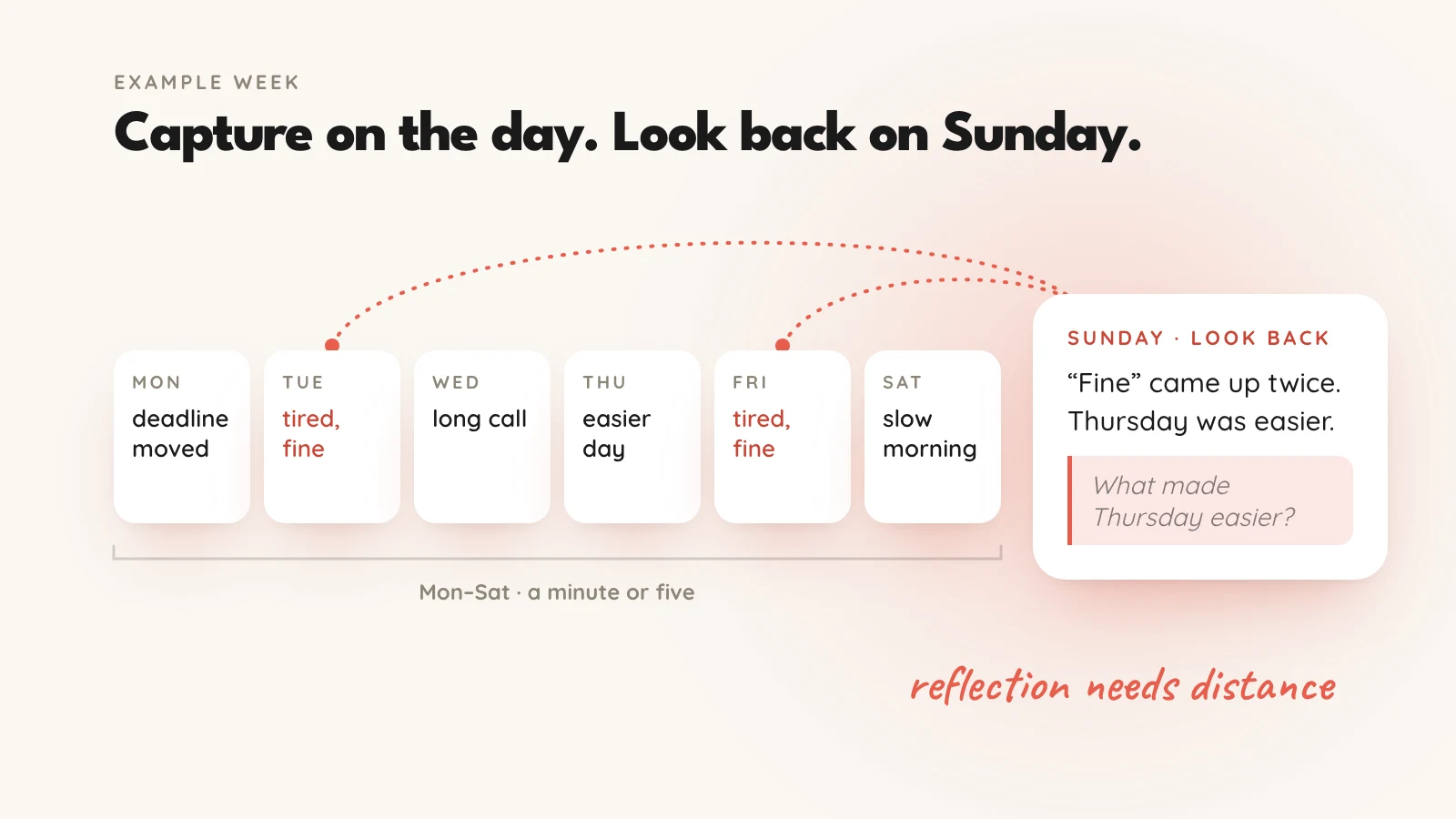
- Capture during the week, reflect at the end of it. On the day, just get it down: what happened, how it felt, one line of why. Don't force the lesson yet.
- Keep the daily part short. A minute or five is plenty. You're collecting material, not writing the essay.
- Pick one fixed look-back. Sunday evening or Monday morning works for most people. Read the week's entries in one go, in order.
- Look for repeats, not highlights. Which person, task or feeling showed up more than once? Repetition is where the week is telling you something.
- Quote yourself. Copy the exact sentence you wrote on Wednesday. Your words from the day are more honest than your memory of them on Sunday.
- End with one question, not a plan. "What made Thursday easier?" is often more useful than a list of five resolutions you won't keep.
Questions for a weekly reflection
When you sit down to look back, try one or two of these:
- What did I mention more than once this week?
- When did I have more energy than I expected, and what was going on?
- What did I call "fine" that I kept coming back to?
- What did I do that helped, even a little?
- What would I want to notice earlier next week?
Why most weekly reflections don't happen
The method is simple. Doing it every Sunday is the hard part. Reading seven entries back takes time, and by the weekend the entries from Monday feel like someone else wrote them. Most people skip the look-back, and without it the daily entries just pile up.
There's a second problem. Even when you do read them, you're the one person who was there for all of it, and that makes the pattern hard to see. The same distance you lacked on Tuesday is still partly missing on Sunday.
How Notka handles the look-back
Notka is a voice journal that writes back. During the week you talk for a minute or five, into the recorder on the web or with a one-press Shortcut on your iPhone, or you type a note if that's easier. After a day with something to say, a short letter arrives the next morning.
On Sunday, a weekly letter does the look-back for you. It reads the whole week, quotes what you actually said with the dates you said it, and points at what repeated. It never tells you what to do. It ends with a question, and the reflecting stays yours. See how it works.
Here is what a weekly letter looks like.
Example letter
Written by Notka for James, a fictional test persona – not a real user.
You made dinner, watched your show, and called it feeling a bit better.
This week reads like you're building a small toolkit for the overwhelming days – one evening it's dinner and your show on 2026-03-17, another it's five miles in Prospect Park to clear your head on 2026-03-21.
On March 17 you wrote: "I took some time to reflect and just focus on self-care. Made a nice dinner and watched a bit of my show." You said it plainly – "It's nice having those moments, especially when things get overwhelming."
What does 'one day at a time' look like tomorrow?