By Notka ·
Morning pages: what they are, why they work, and how to do them out loud
Morning pages are three longhand pages of stream-of-consciousness writing, first thing each morning. Why they work, why people quit, and a spoken version.
Morning pages are three pages of handwritten, stream-of-consciousness writing that you do first thing every morning, about whatever is in your head. The practice comes from Julia Cameron's book The Artist's Way. You don't plan them, you don't polish them, and nobody reads them. Their job is to get the noise out before the day starts.
What are morning pages, exactly?
Cameron's own definition is short: "three pages of longhand, stream of consciousness writing, done first thing in the morning" (Julia Cameron Live, 2020). On the same page she adds that "there is no wrong way to do Morning Pages", that "they are not high art", and that they are "for your eyes only". Her site still lists them first among the four basic tools of the book, alongside artist dates, walks and writing for guidance (juliacameronlive.com).
In an interview with NPR's Life Kit she called them a kind of "brain drain" that lets you "release the worries, fears, and distractions standing between you and your day". The rules she gave there are simple: write three pages by hand, ideally no more than 45 minutes after waking, and don't stop. If you're bored and can't think of anything, write that you're bored (NPR, 2022).
Why do morning pages work?
The short answer is that they give the loose thoughts somewhere to go. A worry that sits in your head keeps asking for attention. Once it is on paper, it can wait.
We could not find a controlled trial of morning pages themselves on PubMed, so be wary of anyone quoting one. The closest research is on short, unedited writing about what is on your mind. In one sleep-lab study, 57 healthy young adults aged 18 to 30 wrote for 5 minutes before bed. Those randomly assigned to write a to-do list of tasks for the next few days fell asleep significantly faster than those who wrote about tasks they had already finished, and the more specific the list, the faster they fell asleep (Scullin et al., 2018). That was bedtime writing, not morning writing, and a small group of students is not you. It does fit Cameron's idea: getting the unfinished stuff out of your head and onto something outside it seems to quiet it down.
The other half of why they work is the lack of judgement. A normal journal entry wants to be about something. Morning pages don't. A grocery list, a rant about your sister, a half-idea for work: it all counts, and that is what lets the stuff you didn't know was bothering you come out on page two.
Why do people stop doing morning pages?
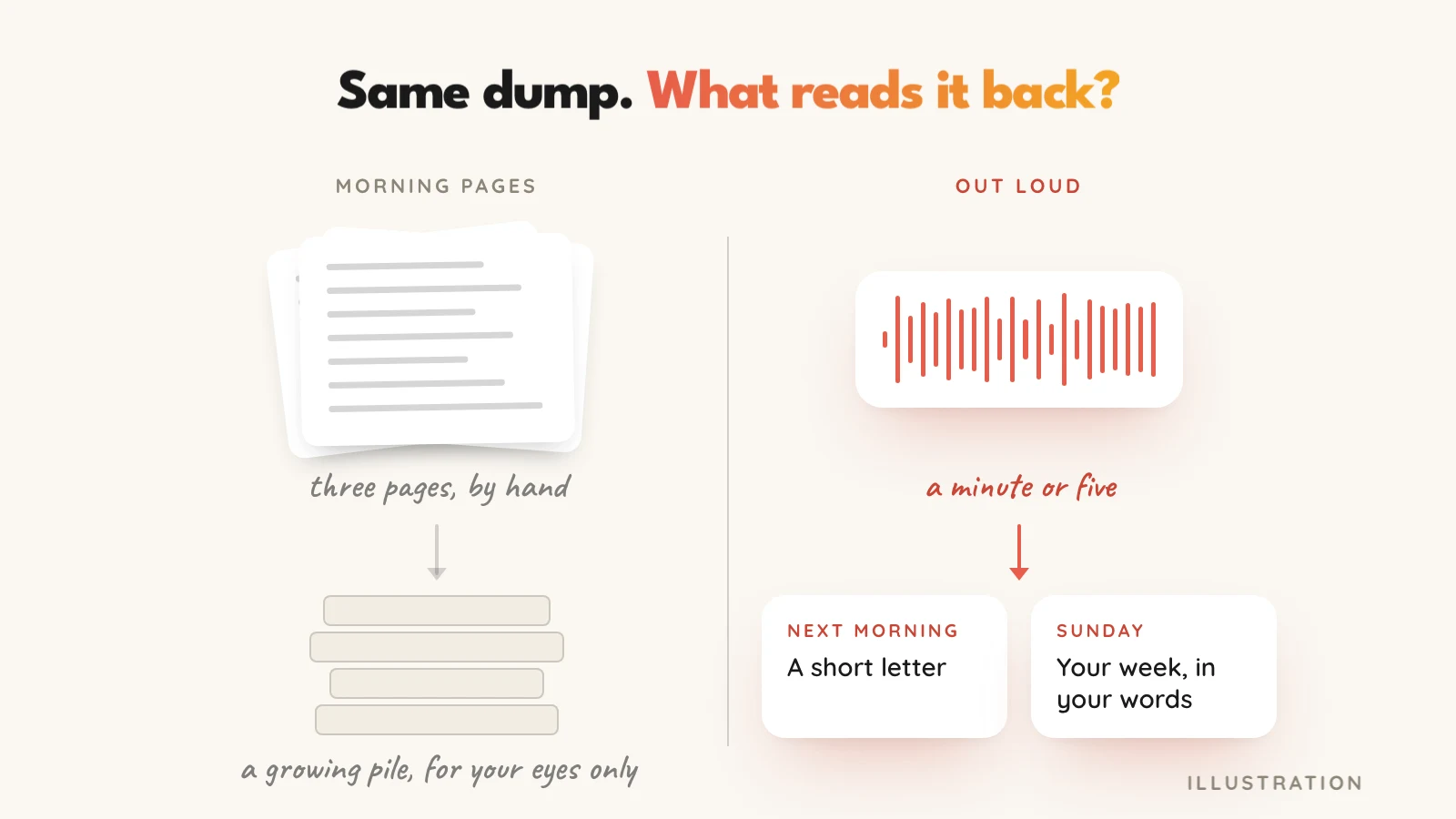
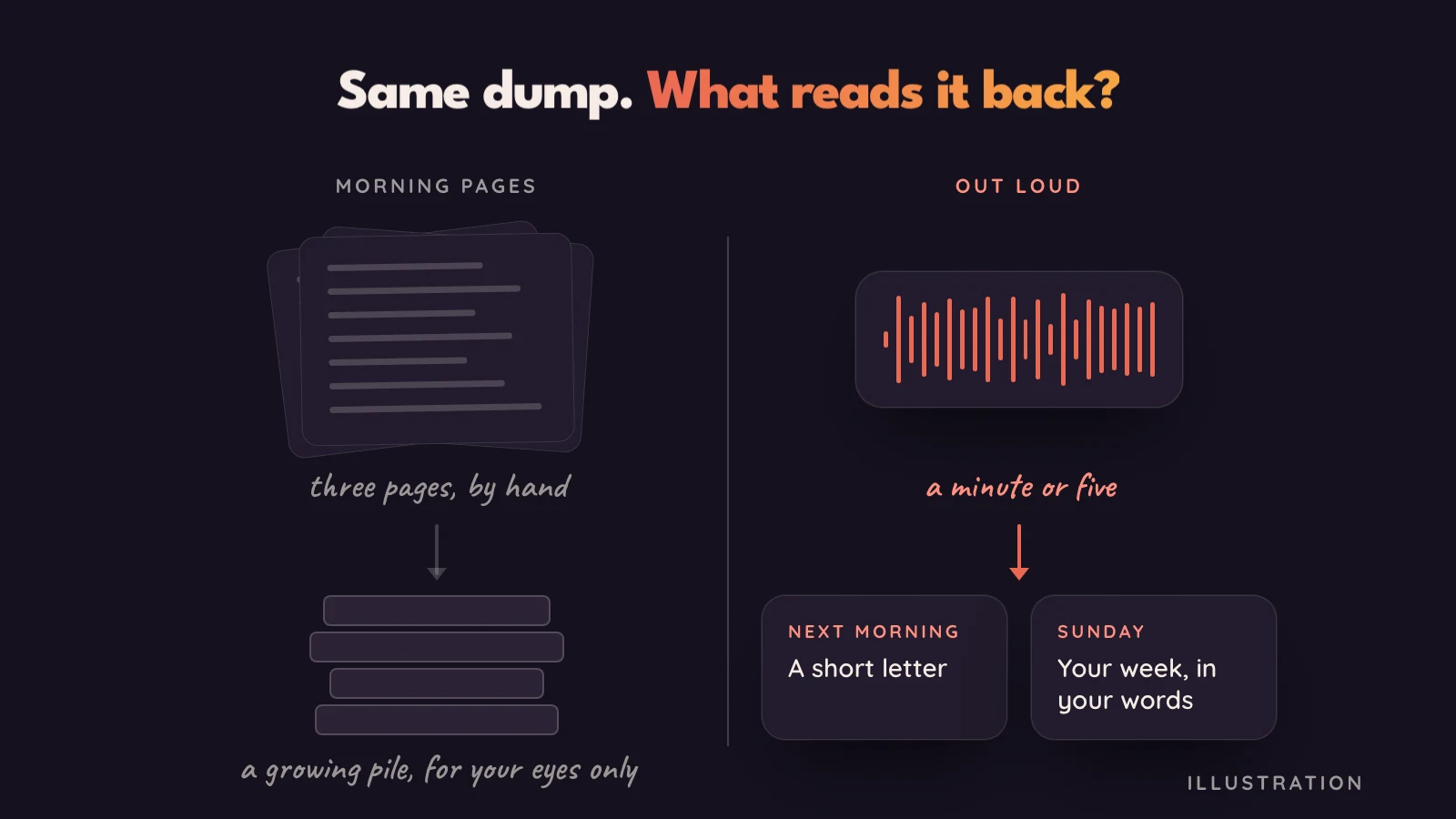
Mostly because of the part that makes them what they are: three pages, by hand, every morning. That is a real slice of the morning before work, school runs or a commute, and on a bad night's sleep it is the first thing to go. Miss two days and the notebook starts to feel like a debt.
There is a second, quieter reason. Cameron tells people doing the book's twelve-week course not to reread their pages until later in the course, and only if asked to (Julia Cameron Live FAQ). That rule is deliberate: pages you know you'll reread turn into pages you perform for. But it means the dump goes in and nothing comes back out. After a few months you have a shelf of notebooks full of your own thoughts, and rereading them is a project nobody has time for. The Tuesday you complained about the same meeting for the fourth week in a row is in there. You just won't find it.
Who should keep doing morning pages by hand?
The handwriting is not a flaw. For some people it is the point, and they should keep it:
- Writers and artists using the pages as a warm-up. Moving a pen for three pages is practice at not stopping, and in NPR's summary of her method, not stopping is the point.
- People who want the slowness. Handwriting forces you to stay with a thought long enough to finish the sentence. If rushing is your problem, the pace helps.
- People who can't talk freely at home. A shared flat, a sleeping partner or thin walls make talking out loud awkward. Paper is silent.
- Anyone who wants the pages to stay unread. If "for your eyes only" matters more to you than looking back, a notebook in a drawer does exactly that.
If you're one of these and the practice is working, don't swap it for anything.
Is stream of consciousness journaling the same thing?
Close. Stream of consciousness journaling is the general idea: write whatever comes, in the order it comes, without editing. Morning pages are one specific version of it, with a fixed length (three pages), a fixed time (first thing) and a fixed tool (a pen). If the format is what stops you, you can keep the idea and drop the format. The part that matters is not stopping to judge what comes out.
How to do morning pages out loud
Talking keeps the dump and skips the handwriting. If you want to try it:
- Pick the same moment each day. Right after you get up, on the walk to the train, while the kettle boils. Cameron's timing is a good default: early, before the day fills your head.
- Talk for a minute or five. You are not trying to fill three pages. Stop when you run dry, not when a timer says so.
- Keep the one rule: don't stop to judge. Say the petty thing, the boring thing, the thing you're not sure about. "I don't know what to say" is a fine start.
- Don't edit or delete. A recording you trim is a recording you're performing for.
- Let something else do the rereading. You won't listen back to a month of recordings, any more than you'd reread a shelf of notebooks.
If a fixed morning slot keeps slipping, a trigger can suit you better than a schedule; we wrote about why in journaling for ADHD. There is more on why talking sticks when writing doesn't in voice journaling.
What Notka does with the dump
Notka is built for exactly this kind of unfiltered talking. You press record on the web or use the one-press iPhone Shortcut, and say whatever is there for a minute or five. Text notes work too, if you'd rather type. Notka transcribes it and keeps it. You never have to look at it again.
Then it does the part a notebook can't. After a day with something to say, a short letter arrives the next morning. On Sunday a weekly one looks back at the week in your own words and dates, and points at what kept coming up: the meeting, the person, the plan you keep calling fine. It never tells you what to do. It asks a question.
So you keep the brain drain and lose the pile. See how the brain dump works, or read how it works end to end.