By Notka ·
How to journal when you hate writing: five-minute sprints and sentence stems
If you hate writing, skip the open page. Finish one sentence, write for five minutes, or make a short list, then stop. Or say it out loud instead.
If you hate writing, don't journal on an open page. Finish one half-written sentence, write fast for five minutes and stop, or make a short list. Give the entry a shape, a time limit and an ending before you start. And if even that feels like writing, say it out loud instead: a minute or five of talking is the same short, contained entry with no page at all.
Why does journaling feel so hard when you hate writing?
Most journal advice comes down to "just write whatever comes". That sounds like the easiest possible instruction. For a lot of people it's the hardest one, because it hands over every decision at once: what the entry is about, where it starts, how long it runs, and when it's done.
People who like writing enjoy that openness. People who don't stare at the page, write two lines, decide they're bad at this, and close the notebook. You have plenty to say. The format asks you for an essay with no topic and no end, and nobody likes writing those.
So change the format and leave your willpower out of it.
What is the Journal Ladder?
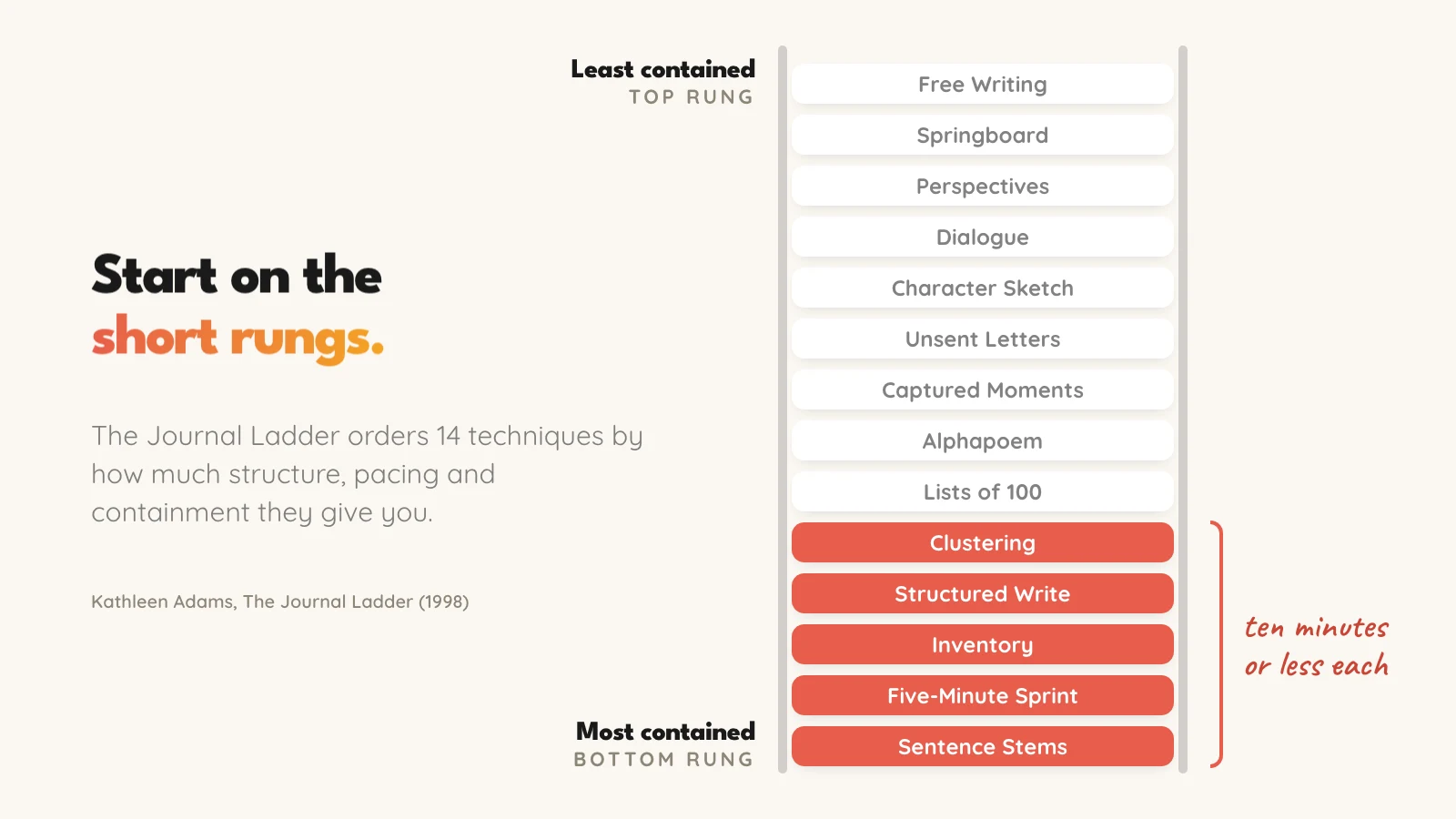
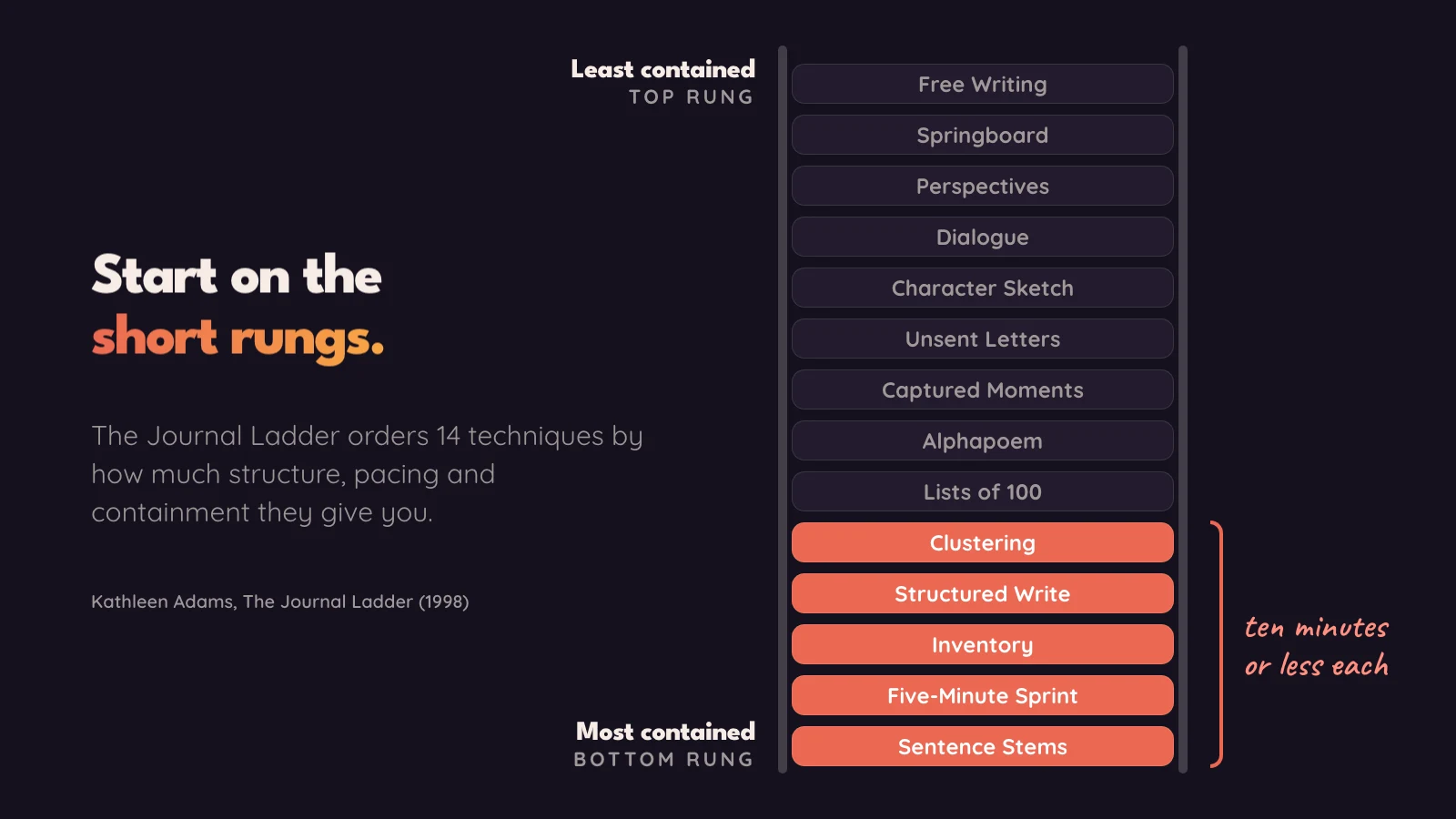
Kathleen Adams, who has worked with journal writing since 1985, sorted the techniques she uses into what she calls the Journal Ladder. It ranks 14 techniques by three things:
- Structure – "foundation, form, sequenced tasks, orderliness"
- Pacing – "rhythm, movement, timing"
- Containment – "boundaries, limits, shape"
At the top sits free writing, the "just write" method. Adams calls it "the default technique of just about every journal writer" and notes that it has no limits: "it can take minutes or hours, paragraphs or pages." At the bottom sit sentence stems, where you only complete a sentence someone else started. Everything else falls in between.
Adams calls free writing a classic and has nothing against it. She places it at the top because it has the least structure, while the rungs at the bottom are the easiest to begin.
Which journaling techniques work if you don't like writing?
The bottom five rungs. Adams writes that they "are by far the most accessible to the largest number of people, because they are short, simple and easy to learn." Each "can be completed in no more than ten minutes", and their structure suits people who are analytically minded "as well as those who have higher levels of reluctance, timidity, or resistance."
She singles out the five-minute sprint as "excellent for those who are resistant or aversive to journal writing, or who are uncertain about how to start, or who state they do not have time to write journals." That covers most people who say they hate writing.
One limit: the Ladder is a framework from a practitioner, built from her own years of teaching. It's not a study, and Adams herself writes that her field "needs much more research to determine whether writing about our problems actually leads to resolution." Treat it as a well-tested way to make journaling smaller, not as proof that it works.
How to journal in five minutes when you hate writing
Pick one of these. Do it once and stop. The examples after the first are ours, not Adams'.
- Finish a sentence stem. Write the start of a sentence and complete it. That's the whole entry. Adams' own examples include "Right now I feel ____", "Right now I should ____" and "I wish I knew ____". One line counts.
- Do a five-minute sprint. Set a timer for five minutes and write fast about whatever is taking up the most room in your life right now. Keep the pen moving until the timer goes off. Adams names the sprint's two structuring elements as "the container of time" and "the crisp pacing of keeping the pen moving". When it ends, reread it and finish one more stem: "As I read this, I notice…"
- Take an inventory. Adams' version is a quick check on life areas like health, family, home and work, to see which "might need attention". Write each area on its own line and add a few words after it. Try: "Work: ____. Sleep: ____. People: ____."
- Chain a few stems. Her "structured write" is a series of stems in a sequence, each going a little deeper. Try three in a row: "Today was ____." "The part I keep thinking about is ____." "What I'd like to happen next is ____."
- Cluster around one word. Write a word in the middle of the page, like "Monday" or a person's name, and draw lines out to whatever it connects to. No sentences needed. Adams adds that "a brief writing to synthesize findings may follow", so one closing stem, such as "The thing that links these is ____", is plenty.
Every one of these has an ending built in. You know when you're done before you start, which is most of what makes them easier than a blank page. If you want a gentle place to begin, How to start journaling covers tying the entry to a moment you already have.
Can you do the same thing out loud?
Yes, and if you hate writing it may be easier still. A sentence stem works the same spoken: press record, say "Right now I feel…", and finish the sentence. A sprint works too: talk for a minute or five about what's on your mind, then stop. The time is the container, and talking keeps its own pace, so you don't have to force it.
What you lose by skipping the page is the picking of words. You can ramble, correct yourself mid-sentence and land on the point halfway through, which is often how thinking goes anyway. Our guide to voice journaling goes into how to do it and what to say.
The step people skip either way is the reread. Adams builds it into the sprint ("As I read this, I notice…"), and says the people she teaches "consistently report noticing greater clarity, connection between thoughts and feelings, and possibilities that had been hidden or ignored." With spoken entries it's even easier to skip, since nobody wants to listen back to themselves.
How Notka handles the rereading
Notka is built around this kind of short, contained entry. You talk for a minute or five, into the recorder on the web or the one-press Shortcut on your iPhone, whenever something is on your mind. You can type a note instead when talking doesn't fit. Use a stem as your opener if a blank start stalls you.
Then Notka does the rereading you'd skip. After a day with something to say, a short letter about it arrives the next morning. On Sunday, a longer one looks across the week and points at what came up more than once. It asks a question rather than telling you what to do. The sprint stays five minutes, and the "As I read this, I notice…" part happens without you having to sit down and do it.